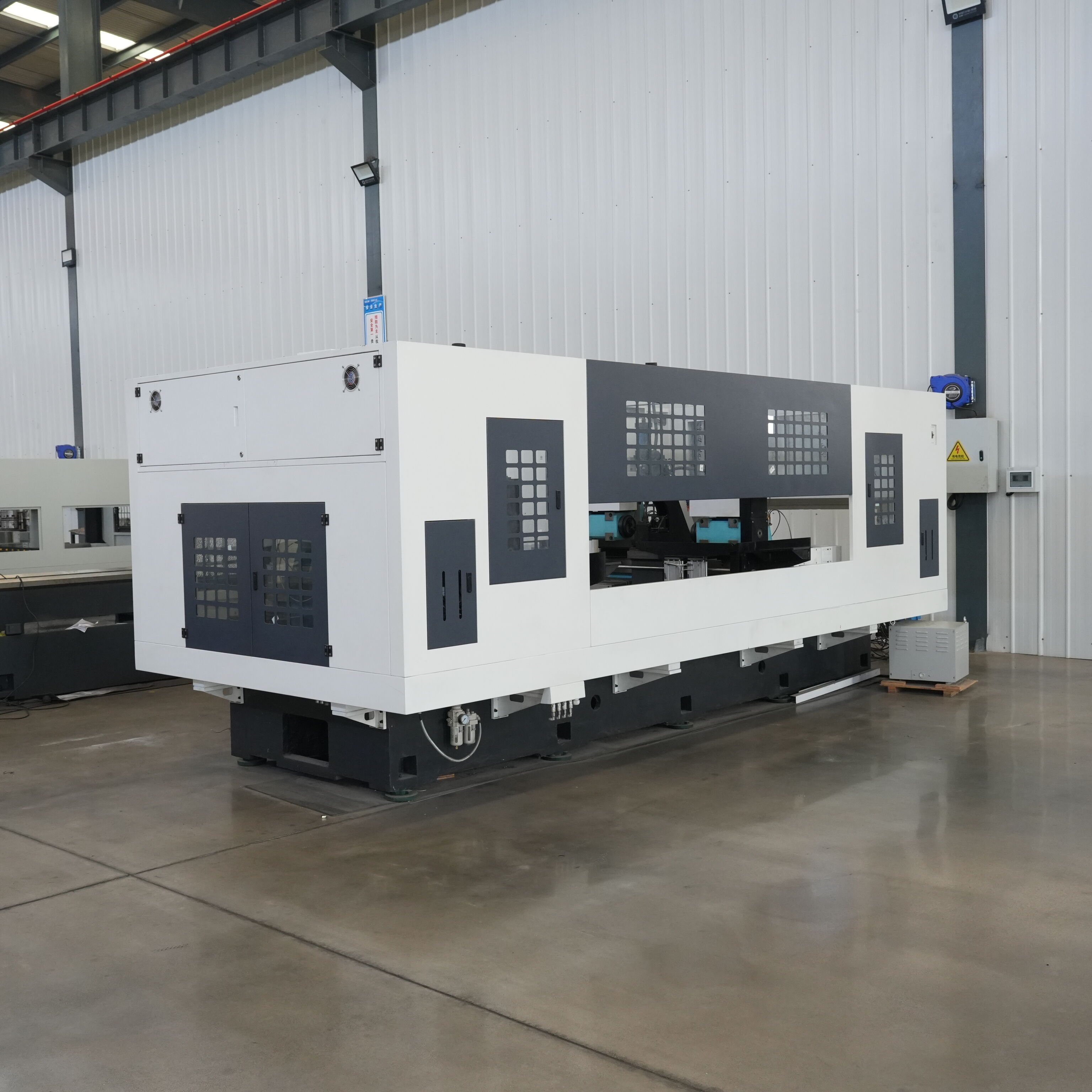
Simultaneous Front- and Back-Side Machining Eliminates Idle Time
How Parallel Spindle Architecture Enables True Overlapped Operations
Dual spindle CNC lathes really boost how fast work gets done because they can do two things at once instead of waiting for one operation to finish before starting another. Traditional machines with just one spindle have to go step by step through each process, which wastes time when changing tools or moving parts around. With these newer dual systems, while the main spindle is doing facing or turning tasks, the second one is already working on the back side features like threads, holes, or grooves. The whole system works together so smoothly that as soon as one spindle wraps up its job, the other picks right up where it left off almost non-stop. Shops running lots of production pieces see their spindle usage jump way above 85 percent compared to the usual 40 to 60 percent range from older single spindle machines. That means factories aren't sitting around waiting as much anymore.
Quantifying Gains: 35–50% Reduction in Total Cycle Time vs. Single-Spindle Lathes
Industry benchmarks confirm a 35–50% reduction in total cycle time for complex, multi-operation parts when using dual-spindle lathes instead of single-spindle equivalents [Industry Report 2023]. This gain arises from two key efficiencies:
- Elimination of manual part transfers between operations
- Removal of secondary setup calibration phases
For instance, a shaft requiring end-drilling and grooving takes 8.5 minutes on a single-spindle lathe—but only 4.7 minutes on a dual-spindle configuration. In batch production, these savings compound: hourly part output increases by 40–60%, directly driven by reduced non-value-added time.
Reduced Handling Waste and Work-in-Process Through Integrated Automation
Eliminating Manual Transfers and Secondary Setups with In-Machine Part Transfer
With dual-spindle CNC lathes, parts get machined on both sides during one setup, so there's no need for workers to handle them between machines. Once the primary spindle finishes working on the front side of a component, the machine itself moves it over to the secondary spindle for the backside machining. This approach saves time because traditional methods would require setting up the part again, something that usually takes around 15 to maybe 30 minutes per piece. When humans aren't involved in moving parts around, factories see fewer defects caused by mishandling, sometimes cutting them down by as much as half. What's really important is that keeping everything clamped consistently helps maintain accurate measurements throughout production runs. Parts stay within tight tolerances, typically staying within plus or minus 0.005 millimeters from batch to batch, which makes all the difference when quality matters most.
Bar Feed + Dual-Spindle Synchronization Cuts Non-Cutting Time by ~70%
When bar feeders get paired up with those dual spindles that work in sync, it basically turns into a never-ending production line. The trick is simple really - while one side of the machine finishes off a part, the other side is already grabbing hold of the next piece from the metal bar and getting it ready for machining. This back and forth saves tons of downtime because there's hardly any waiting around between operations. Most shops notice about a 70% cut in all that wasted time that used to happen when switching parts manually. For companies running big batches, the gains are even bigger. Cycle times get slashed somewhere between 30 to 50 percent, half the work in progress piles up on the floor, and folks who run these shops report roughly 18% less scrap caused by handling errors. These numbers come straight from the shop floor reports at various aerospace and medical device manufacturing plants.
Enhanced Accuracy and Cost Efficiency via Single-Setup Completion
Minimizing Datum Shift, Clamping Errors, and Repeatability Loss
When everything happens in one continuous setup, dual spindle lathes cut down on those annoying tolerance errors that come from having to clamp parts multiple times, realign datums, and deal with inconsistent fixtures. Research indicates that machining in a single setup can actually reduce dimensional problems by around 30 percent when compared to traditional multi stage approaches. No need for so much manual handling means there's just less room for human error, which results in consistent measurements down to about plus or minus 0.005 mm throughout long production batches. For things like hydraulic valves and drive couplings that require tight tolerances, this kind of precision really matters because if surfaces don't align properly, the whole system won't function as intended.
ROI Analysis: <18-Month Payback for High-Mix, Medium-Volume Shops
For high-mix, medium-volume shops, dual-spindle CNC lathes deliver rapid return on investment—typically within 14–18 months—through operational consolidation and quality improvements. A 2023 benchmark analysis found that facilities achieve full ROI via:
- 40% lower per-part labor expenditure
- 28% reduction in scrap material costs
- 60% faster job changeovers
These gains stem directly from eliminating secondary fixtures, reducing WIP inventory, and consolidating turning, drilling, and threading into a single cycle. The system's flexibility across varying batch sizes makes it especially advantageous for job shops managing diverse contracts.
FAQ Section
What are the benefits of using dual spindle CNC lathes?
Dual spindle CNC lathes allow simultaneous front and back-side machining, eliminating idle times and reducing the total cycle time by 35–50%. This efficiency boost can increase spindle usage up to 85% in production settings.
How do dual spindle CNC lathes improve handling and work-in-process?
They minimize manual transfers and secondary setups through in-machine part transfer, reducing defects and ensuring parts remain within tight tolerances.
What is the expected return on investment when using dual spindle CNC lathes?
For high-mix, medium-volume shops, the expected ROI is typically within 14–18 months, thanks to operational consolidation and quality improvements.