
Why Batch Consistency Is Harder Than Hitting Tolerance on One Part
Getting a single part within tolerance is a skill. Getting ten thousand parts within tolerance, shift after shift, is a system. A cnc turning service earns its keep by building that system around the machine, not just by hiring a good operator.
The first part off a machine often looks great. Tools are fresh, the spindle is cold, and the operator is paying close attention. The problems show up later. Tool wear shifts the cutting edge. Thermal growth moves the turret. Material hardness varies from lot to lot. A turning service that only checks the first article and then walks away is not really controlling consistency. It is hoping for it.
Real consistency comes from process control. That means documented tool life limits, warm-up cycles, coolant temperature management, and a feedback loop that catches drift before the scrap bin fills up.
How Workholding and Setup Choices Shape Concentricity
Every time a part gets re-chucked, error creeps in. Chuck jaw wear, chip contamination, and clamping pressure variation all add up. For shaft work, roller components, and sleeves, those errors show up as runout, taper, or wall thickness variation.
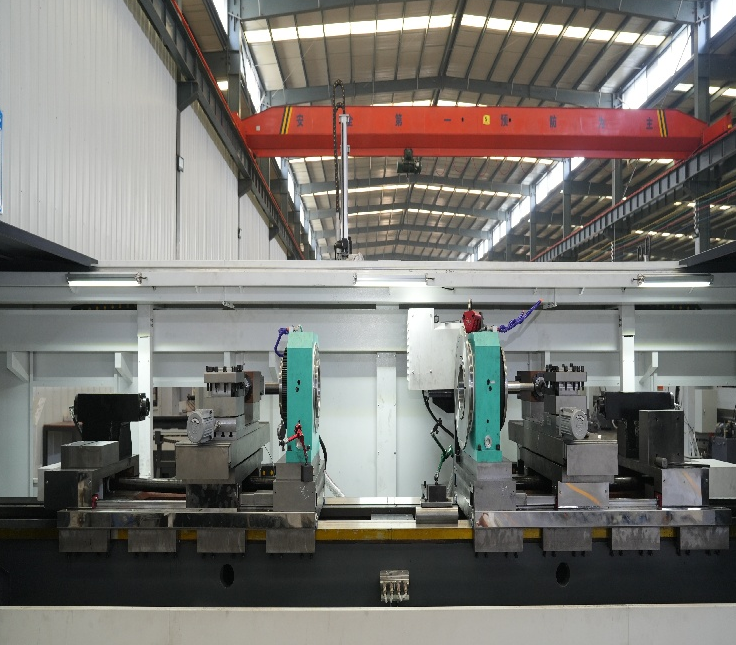
A double-spindle or double-end machine changes the math. Once the workpiece is clamped, both ends can be machined without a second setup. Concentricity becomes a function of spindle bearing quality and chuck repeatability rather than the alignment between two separate operations. Workpiece rotation instead of tool rotation also helps, because the part spins on its own axis and the tool stays fixed. That reduces the centripetal error that grows with spindle speed on older tool-rotation designs.
The trade-off is flexibility. A double-end machine is built for parts that need both ends worked. If a job requires a lot of cross-drilling or milling on the same setup, a single-spindle lathe with live tooling may still be the better fit. Honest evaluation matters more than a blanket recommendation.
Tool Wear and Thermal Drift: The Variables Nobody Talks About Enough
Two variables cause more consistency problems than any control system can fix on its own. The first is tool wear. A carbide insert that cuts cleanly at 8 minutes may start pushing dimensions at 22 minutes. Without a tool life management plan, the operator becomes the feedback loop, and that is not reliable across three shifts.
The second is thermal drift. According to research published by NIST and CIRP, thermal errors can account for 40 to 70 percent of total machining error. Spindle growth, ballscrew expansion, and coolant temperature swings all move the cutting point. A shop that runs a warm-up cycle, stabilizes coolant temperature, and uses thermal compensation in the control can hold tighter bands across a long production run.
Neither fix is glamorous. Both are standard practice in shops that actually hit consistent numbers.
In-Process Inspection and Data Feedback Close the Loop
Consistency is not a one-time achievement. It is a loop. First article inspection confirms the setup. In-process gauging catches drift. Statistical process control turns measurements into trends. When the trend line starts moving, the operator adjusts before the part goes out of tolerance.
A turning service that uses CMM reports, air gauging, or laser measurement on the floor can react faster than one that waits for the quality lab. The data also feeds back into tool life settings and offsets. Over time, the process gets tighter, not looser.
A Side-by-Side Look at Turning Accuracy by Machine Type
Different machine configurations deliver different consistency ceilings. The table below shows typical ranges, not guarantees. Material, tooling, and thermal management still matter.
| Machine Type | Typical Concentricity (TIR) | Number of Setups for Two-End Part | Batch Consistency | Operator Dependence |
|---|---|---|---|---|
| Manual lathe | 0.002 to 0.005 in | Two or more | Low | High |
| Single-spindle CNC | 0.0005 to 0.001 in | Two | Medium | Medium |
| Dual-spindle CNC | 0.0003 to 0.0008 in | One | High | Low |
| Double-end CNC | 0.0002 to 0.0006 in | One | High | Low |
The jump from manual to CNC is obvious. The jump from single-spindle to dual-spindle is where many shops see the biggest gain in consistency, because the second setup disappears. That is not a sales pitch. It is geometry.
What to Ask a CNC Turning Service Before Sending Production
A few questions separate a capable turning service from a busy one.
How is tool life managed, and who adjusts offsets when wear appears?
What is the warm-up procedure, and how is coolant temperature controlled?
Is in-process measurement used, or only final inspection?
How are setup sheets and first article reports documented?
What happens when a batch starts drifting? Who makes the call to stop?
A chemical plant retrofit project in southern China offered a clear lesson. A batch of pump sleeves started showing ovality halfway through a production run. The turning service initially blamed the material. A closer look found the coolant chiller was cycling on and off, causing the spindle to grow and shrink by a few tenths. Once the chiller was stabilized and a warm-up cycle was added, the ovality disappeared. The fix cost almost nothing. Finding it required a service that understood the process, not just the machine.
For operations that need consistent shaft, sleeve, and roller turning, Hengxing has spent more than two decades developing automatic double-head CNC lathes, double-head drilling machines, and double-sided milling machines. The company's focus on rigidity, thermal stability, and practical process control makes it a useful partner for shops that care about batch consistency as much as single-part accuracy.
Table of Contents
- Why Batch Consistency Is Harder Than Hitting Tolerance on One Part
- How Workholding and Setup Choices Shape Concentricity
- Tool Wear and Thermal Drift: The Variables Nobody Talks About Enough
- In-Process Inspection and Data Feedback Close the Loop
- A Side-by-Side Look at Turning Accuracy by Machine Type
- What to Ask a CNC Turning Service Before Sending Production