Why Programming Skills Matter for CNC Drilling
Programming is the language that tells a CNC driller what to do. Without it, the machine is just metal and motors. With it, the machine becomes a precision tool that can drill the same hole in the same spot thousands of times. For shops that make mining roller shafts, automotive axles, or hydraulic rods, programming skill directly affects cycle time, tool life, and part quality. A poorly written program can cause tool breakage, scrap, or even a crash. A well written program can cut cycle time by half and hold tolerances that keep customers coming back. The basics are not complicated, but they must be learned correctly. Every operator who understands G code, coordinates, and offsets becomes more valuable to the shop. That is why programming basics deserve serious attention.
Understanding the Coordinate System and G Code
At the heart of CNC programming is the coordinate system. The machine needs to know where the part is and where the tool should go. Most CNC drillers use a Cartesian system with X, Y, and Z axes. The Z axis usually controls depth. The X and Y axes control position on the part. A work offset tells the control where the part zero is located. A tool offset tells the control how long the tool is. G code is the instruction set. G00 moves the tool quickly to a position. G01 moves it in a straight line at a controlled feed rate. G81 is a simple drill cycle. G83 is a peck drill cycle for deep holes. M codes handle spindle on, coolant on, and tool changes. For a dual head or dual spindle machine, the programmer must also manage two tools or two spindles at once. That adds complexity but also adds speed. Understanding these basics is the first step toward reliable production.
Setting Tool Offsets and Work Offsets Safely
Tool offsets and work offsets are where many crashes happen. A wrong offset can send a tool into the fixture or the chuck. That is why safe programming starts with careful measurement. Touch off each tool on a known surface. Record the offset values. Verify the work offset with a test run above the part. Use single block and dry run to check the path. On a hydraulic double spindle CNC lathe, the clamping force and part position must be stable before the program runs. If the part moves, the offset is meaningless. Experienced programmers often write a safety block at the start of the program. That block might include a spindle speed limit, a feed rate limit, and a tool change position that is clear of the part. These habits are not optional. They are the difference between a productive shift and a costly accident.
Optimizing Cycle Time with Dual Spindle and Dual Head Machines
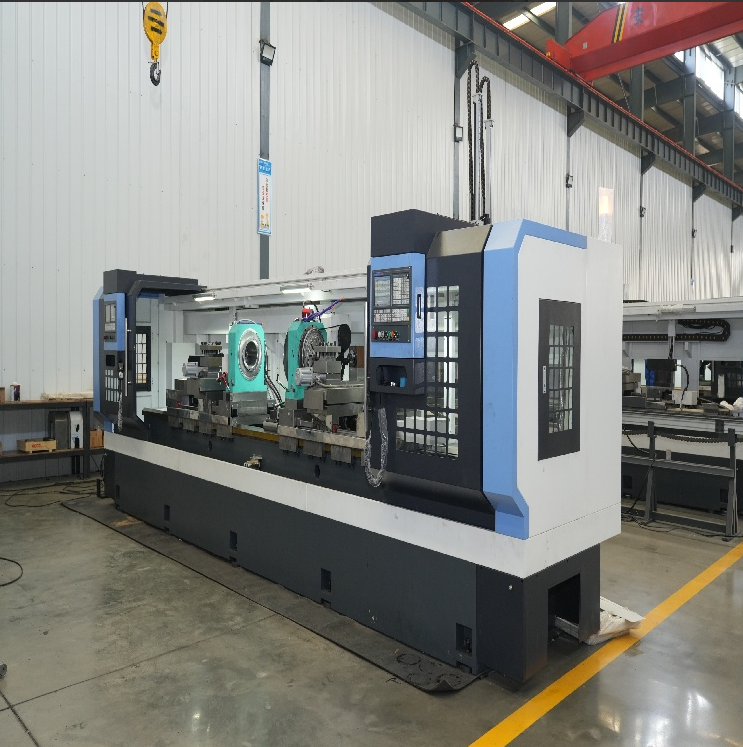
Cycle time is money. A dual spindle or double head CNC driller can process both ends of a shaft in one setup. That eliminates a second clamping operation and reduces handling time. But the programming must match the machine. The programmer must decide which spindle does which operation. They must balance the workload so one spindle does not wait for the other. They must coordinate the tool changes and coolant commands. On a machine with automatic loading and unloading, the program must also sequence the robot or loader. Canned cycles help. Peck drilling helps clear chips and avoid tool breakage. High pressure coolant helps with deep holes. The goal is to keep the spindle cutting as much as possible. Every second of air cutting is a second of lost profit. Shops that master this balance see throughput increase by up to two hundred percent compared with single spindle machines.
Real World Example from the Shop Floor
A heavy equipment shop had a problem. They drilled long shafts for mining rollers on two separate manual drill presses. Each shaft required two setups. Alignment was inconsistent. Scrap was high. The skilled operator was nearing retirement. The shop invested in a dual head CNC driller with hydraulic clamping. The first program was written by a young technician who had learned G code at a local technical college. He started with a simple G81 cycle for each end. Then he added a peck cycle for the deeper holes. He set the work offset once and used the same offset for both ends. He ran a dry run with the tool far above the part. Then he ran a single part and checked the hole positions with a coordinate measuring machine. The results were good. Cycle time dropped from twelve minutes to five minutes. Scrap dropped to nearly zero. The shop now runs the machine unattended for part of the shift. That is the power of programming basics done right.
Partnering with Hengxing for Programming and Manufacturing Support
Good programming requires good equipment. Shandong Hengxing Heavy Industry Technology Co., Ltd., known as Hengxing, builds CNC double head lathes, CNC double head drilling machines, and double sided automatic milling machines. Hengxing serves mining, automotive, aerospace, and precision machinery customers with a strict quality management system. The company supports customers from the first process discussion through prototype testing and mass production. For shops that need to drill both ends of a shaft with high precision and lower labor cost, Hengxing can propose a configuration that fits the part and the budget. With an overseas service network that reaches more than thirty countries, including the Netherlands, Brazil, Canada, India, Indonesia, Vietnam, and Turkey, Hengxing provides long term technical guidance and transparent spare parts supply. Programming basics are the foundation. The right machine and the right partner turn that foundation into a competitive advantage.
Table of Contents
- Why Programming Skills Matter for CNC Drilling
- Understanding the Coordinate System and G Code
- Setting Tool Offsets and Work Offsets Safely
- Optimizing Cycle Time with Dual Spindle and Dual Head Machines
- Real World Example from the Shop Floor
- Partnering with Hengxing for Programming and Manufacturing Support