
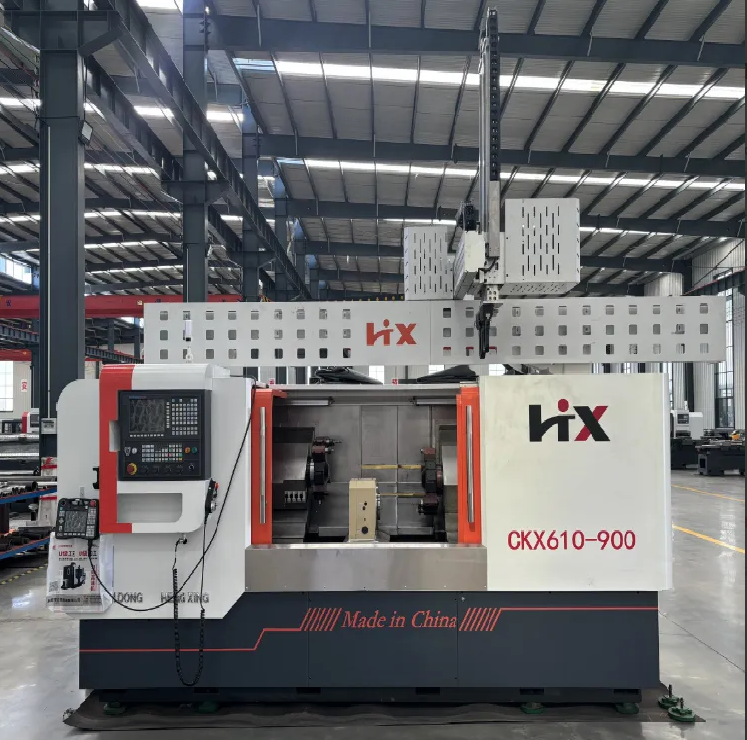
What to Look for in a Slant-Bed CNC Lathe Manufacturer
Selecting a slant-bed CNC lathe is rarely a casual purchase. It is often the backbone of a production line that demands unyielding precision and repeatability. However, the market is saturated with manufacturers whose brochures look identical. To distinguish genuine engineering from superficial marketing, you must look beyond the paint job and the glossy spec sheets. After spending years on the floor observing how these machines behave under load, it becomes clear that the real value lies in a few critical, non-negotiable truths.
The Physics Behind the Slant Design
The primary reason a slant-bed exists is not just to save floor space; it is a masterclass in physics. The angled configuration uses gravity to divert chips away from the cutting zone and into the conveyor. This sounds trivial, but in high-volume turning, a pile of hot, tangled chips can cause thermal distortion in the bed and re-cutting of swarf, instantly ruining surface finishes. A well-executed slant-bed design, typically with a true 45-degree angle, maximizes rigidity by symmetrically distributing cutting forces into the bed without twisting. When evaluating a manufacturer, ask how their structural casting handles thermal symmetry. A foundry that engineers uniform wall thickness in the base casting ensures the machine grows thermally in a predictable, linear way, rather than warping unpredictably during a long, unattended night shift.
The Integrity of the Mechanical Anatomy
Any seasoned maintenance engineer will tell you that a machine’s soul lives in its spindle and linear guides. But raw specifications like “high RPM” or “roller type rails” tell only a fraction of the story. The real expertise of a manufacturer is evident in the thermal management of the headstock. Look for designs where the spindle bearings are precisely preloaded and lubricated to maintain a cool nose profile, even at maximum sustained speeds. If the nose heats up and expands, your axial accuracy vanishes. Furthermore, the marriage between the ball screws and the servo motors must be rigid. A high-quality machine avoids cheap, flexing couplings. Instead, direct drive or heavy-duty couplings that require zero backlash are mandatory. You can usually sense this quality by simply checking the motion smoothness manually; a jerky handwheel feedback often betrays internal mechanical compromise. You want a builder who treats the machine as a precision instrument, not a mere assembly of commodity parts.
The Symbiosis Between Metal and Code
Modern machining is a duet between the iron and the control system. While many brands integrate the same names like FANUC or Siemens, the difference lies in the ladder logic and macro programming the manufacturer implements. A knowledgeable partner focuses on operator ergonomics. They do not just install a standard screen; they create custom conversational programming wizards that reduce setup time by guiding the operator through complex turning cycles. This signals deep trustworthiness. A manufacturer who invests in the human-machine interface acknowledges that the user’s learning curve directly impacts productivity. Furthermore, the electrical cabinet wiring should be a work of art, with clearly labeled, heat-shrunk ferrules and segregated high and low-voltage channels. This level of craftsmanship prevents noise interference, ensuring the digital signal is as stable as the machine’s casting, which is crucial when interpolating arcs at high feed rates.
Precision Verification Beyond the Brochure
This is the moment of truth. Every seller promises micron-level precision. A credible manufacturer proves it with data that can be replicated. You are not just looking for a certificate of inspection; you are looking for evidence of a dynamic mechanical validation. For instance, the factory must perform a Ballbar test and laser interferometry under workshop conditions, not just theoretical lab settings. The Ballbar reveals the machine’s true servo mismatch, backlash reversals, and squareness errors, giving you an honest health report of the geometry. The most authoritative manufacturers export these raw, unedited reports tied to a specific serial number. They are not hiding behind vague tolerances but openly declaring that a machine achieves consistent circularity. When you see a manufacturer displaying their laser calibration equipment proudly in a dedicated metrology area, you are witnessing a culture of accountability. This is the dividing line between a supplier who guesses and a partner who guarantees.
From Factory Floor to Fiscal Year Value
The ultimate goal of these technical nuances is business profitability. A strategically sourced slant-bed lathe is less of an expense and more of a revenue catalyst. When a machine reduces cycle times through rigid cutting and rapid servo optimization, you multiply throughput without multiplying the wage bill. This is the real link between rigidity and return on investment. An efficient, thermally stable machine also allows for “lights-out” automated production, transforming a standard 8-hour shift into a 24-hour profit center. Think of the long-term cost avoidance: superior way covers sealing out chips, centralized lubrication preventing slideway wear, and parts commonality reducing your inventory nightmare. A manufacturer that designs for maintainability directly protects your capital expenditure, ensuring the machine does not nickel and dime you in downtime over the subsequent decade.
The History Written in Steel
Ultimately, the most authoritative indicator of a good manufacturer is not found in a catalog but in their legacy. Look for a company that isn’t just a trading office with a website, but an entity rooted in core mechanical processing itself. The difference is profound. When a brand has a deep history of crafting key mechanical parts, they bring a relentless understanding of cutting forces to their machine tool assembly. For example, consider an enterprise like HXCG. Their roots in heavy-duty, high-precision mechanical processing mean they design lathes with the intimate knowledge of a user, not just a theorist. They understand that bearing journals require absolute concentricity, so they build their spindles with that same obsessive standard. This deep supply chain integration and self-reliant manufacturing capability translate to a level of quality control that third-party assemblers simply cannot replicate. When you choose a partner, you are not just buying the machine sitting on their floor today; you are buying into a decade of accumulated processing wisdom and the assurance that service support is backed by genuine engineering capability, not outsourced guesswork. That silent confidence is what keeps a factory running.