What Is a Dual Spindle CNC Lathe?
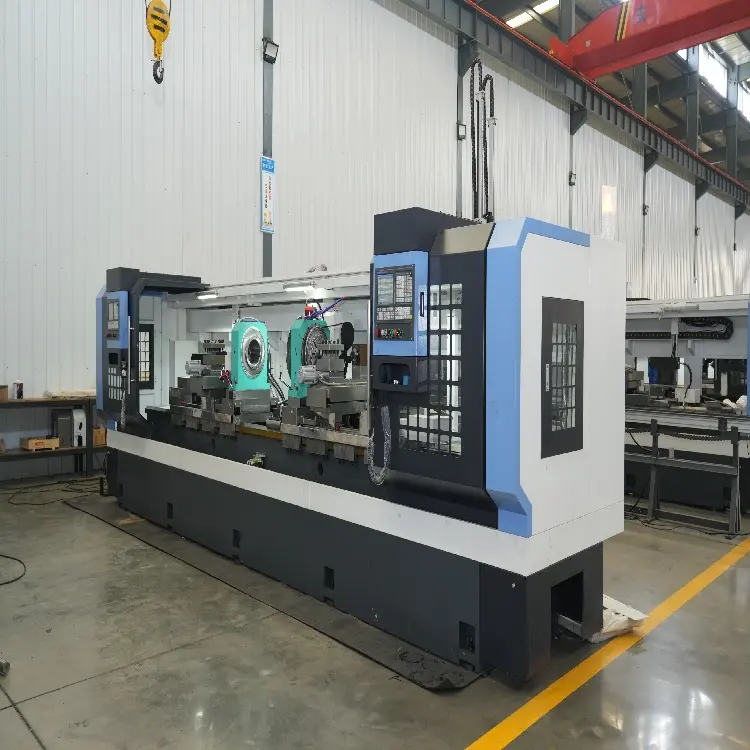
Core Architecture and Operational Principle
Dual spindle CNC lathes combine two separate spindles, one primary and one secondary, all within a sturdy machine frame. The process starts when parts get worked on in the main spindle area for things like turning, facing, or grooving operations. Once that's done, special transfer systems take over automatically. These can be bar pushers, robotic arms, or shuttle mechanisms that move the finished piece across to the secondary spindle without needing any manual help from operators. While the second set of operations happens on the transferred part, including tasks such as back facing, drilling, threading, or even some milling work, the main spindle is already getting ready for the next job. This kind of overlapping production reduces downtime significantly, somewhere around 35-40% according to various shop floor studies. Manufacturers maintain tight tolerances thanks to synchronized drive systems, strong clamping solutions, and extremely accurate spindle alignment down to sub micron levels.
Key Differences from Single-Spindle and Multi-Axis Lathes
With single-spindle lathes, workers have to manually or semi-automatically re-chuck parts when moving to second operations. This process introduces alignment issues around +/- 0.005 inches plus all sorts of setup errors that build up over time. Dual spindle systems cut out these problems completely. These machines finish both sides of a component during one continuous run, which can slash overall cycle times by as much as 60% for parts that need symmetrical processing. Multi-axis lathes take a different approach altogether. They incorporate Y or B axis movements for those tricky contours and off-center milling tasks, but most still rely on just one spindle. While great for complicated geometries, they simply cant match dual spindles when it comes to working on both ends at once. That makes dual spindle lathes ideal for shops doing large volumes of two-sided precision work where getting consistent results fast matters more than anything else.
Key Advantages of Dual Spindle CNC Lathe Systems
Dual spindle CNC lathes deliver transformative gains in efficiency, accuracy, and process reliability—particularly for parts requiring complete machining on both ends.
Reduced Cycle Time Through Simultaneous Machining
- Parallel Processing: Front-end and back-end operations run concurrently—e.g., rough turning on the main spindle while finishing the opposite end on the sub-spindle—cutting cycle times by 30–50% versus sequential single-spindle methods.
- Automated Transfers: Integrated part-handling systems enable uninterrupted production. Once primary machining finishes, the workpiece transfers automatically, allowing the main spindle to begin its next cycle without delay—critical for high-volume runs.
Improved Part Accuracy and Consistency with Minimal Handling
- Single-Setup Completion: Parts undergo all critical operations—including secondary features like cross-holes or back-boring—without repositioning. This eliminates cumulative fixturing errors and reduces tolerance stack-up by up to 70%, per industry validation studies.
- Enhanced Surface Integrity: Close-proximity tooling, minimized overhang, and synchronized spindle dynamics suppress vibration and deflection. The result is repeatable surface finishes under 0.4 μm Ra—even on slender or thin-walled components.
Top Industrial Applications for Dual Spindle CNC Lathe Machines
Dual spindle CNC lathes are indispensable in sectors demanding tight tolerances, high repeatability, and rapid throughput across large batches or complex geometries.
High-Volume Precision Components in Automotive and Medical Sectors
Dual spindle lathes are essential in automotive manufacturing where they make transmission shafts, CV joints, and engine valves that maintain tight dimensional tolerances around plus or minus 0.005 mm even when producing tens of thousands of parts. The medical industry also depends heavily on these machines for making surgical tools and titanium implants needed for bones. These devices can create surfaces smooth enough to meet biocompatibility standards (below Ra 0.4 microns) while keeping things clean since everything happens inside sealed enclosures without any human contact during processing. When there's no need to move parts manually from one operation to another, manufacturers get better consistency between batches and can track every component according to FDA requirements for compliance purposes.
Complex Turn-Mill Parts Requiring Secondary Operations on the Fly
What makes these machines stand out is their ability to handle live tooling along with C-axis interpolation across both spindles at once. This means they can do milling work, drill holes, tap threads, and create complex contours all while the part is being turned. Take a look at how it works practically: imagine one spindle doing the rough turning on a stainless steel coupling while another spindle is busy drilling and threading the opposite side right at the same time. The real value becomes clear when looking at specialized components like those complicated aerospace fittings that need 5-axis contours or hydraulic manifolds where multiple holes intersect. When manufacturers can finish these intricate parts without switching between different machines, there's better overall accuracy and significantly fewer rejected pieces. Some shops report cutting down on scrap material by around 25-30% simply by consolidating operations into this single machine setup rather than bouncing parts between several different machines throughout production.
How to Select the Right Dual Spindle CNC Lathe for Your Production Needs
Evaluating Spindle Synchronization, Tooling Capacity, and Automation Readiness
Getting spindle synchronization right is really important for machine shops. Look for something around 0.005 mm or better repeatability between spindles so they don't start drifting apart during those simultaneous operations. Turret capacity shouldn't be overlooked either. Machines with at least 24 stations can handle all sorts of different tools needed for complicated turn-mill jobs. And when these turrets come with quick change hydraulic holders? Setup times drop dramatically, maybe even cut down by about 40% in shops that run lots of different parts. Shops should definitely consider machines that have open automation ports and standard connections. Things like M-code compatibility, proper I/O modules, and good old Ethernet/IP support make it much easier to hook up with bar feeders, gantry loaders, or work alongside cobots. A recent report from the International Federation of Robotics showed that shops using dual spindle machines ready for automation saw their equipment utilization jump by roughly 30%. Makes sense when thinking about long term productivity.
Matching Machine Specifications to Part Complexity and Batch Size
When working with hardened steels or Inconel materials, the machine needs at least 15 kW of spindle power along with proper torque delivery and structural rigidity matching what the job demands. Steel work generally calls for frames that are about 30 percent stiffer compared to aluminum parts. If doing live tooling operations or complex C-axis contours, check those Y-axis travel limits first. The sub-spindle positioning must be really accurate too, ideally within plus or minus 0.003 mm or so. Small production runs get a big boost from machines equipped with programmable presets and modular tooling setups. These features cut down on setup times to less than ten minutes between jobs. For large volume manufacturing lines running long shifts, thermal compensation systems become essential alongside real time error mapping capabilities to maintain tolerances around 0.01 mm throughout entire production cycles. According to recent findings from NIST's 2023 study on advanced manufacturing practices, getting these specs right can slash scrap rates by nearly a quarter while also reducing typical cycle times by almost 20%.
FAQ
What is a dual spindle CNC lathe?
A dual spindle CNC lathe is a machine that features two spindles, allowing for simultaneous operations on both ends of a workpiece, improving efficiency and accuracy.
How do dual spindle CNC lathes differ from single-spindle and multi-axis lathes?
Unlike single-spindle lathes, dual spindle CNC lathes finish both sides of a component in one continuous run, reducing cycle times significantly. They differ from multi-axis lathes because they can work on both ends simultaneously, whereas multi-axis lathes usually have one spindle and focus on complex geometries.
What are the advantages of using dual spindle CNC lathes?
Dual spindle CNC lathes offer reduced cycle times, improved part accuracy, and increased process reliability. They are particularly beneficial for high-volume, precise, two-sided machining tasks.
What industrial sectors benefit most from dual spindle CNC lathes?
The automotive and medical sectors benefit greatly from dual spindle CNC lathes due to their capability to produce high-volume precision components and meet stringent compliance requirements.
How to choose the right dual spindle CNC lathe?
When selecting a dual spindle CNC lathe, consider factors such as spindle synchronization, tooling capacity, automation capabilities, and machine specifications that match the part complexity and batch size of your production needs.