
CNC Milling Automation and Productivity
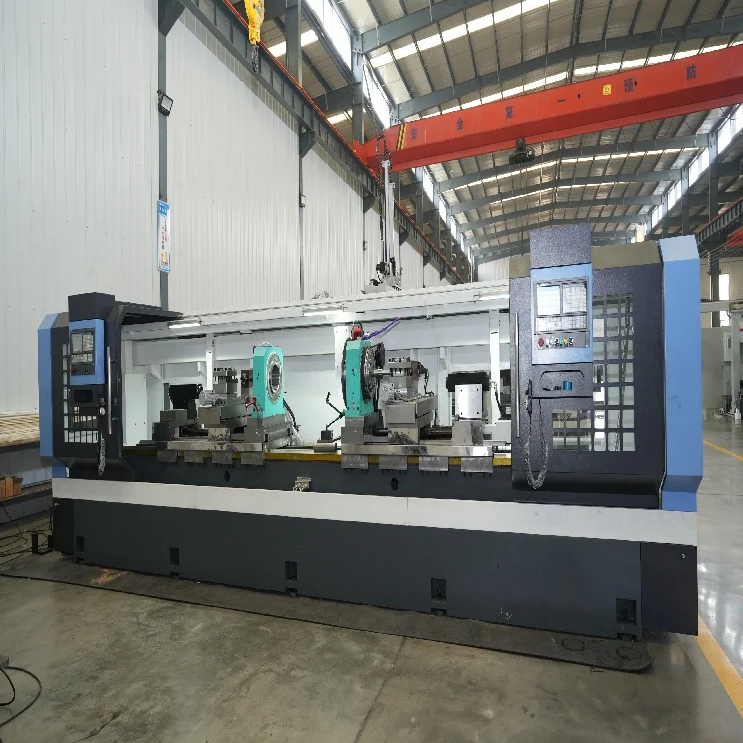
CNC milling automation is not just about making a machine run faster. It is about removing the hidden delays that eat up a shift. Loading, unloading, clamping, moving a part from one end to the other, checking size, and waiting for an operator all add up. When a shop machines long shaft workpieces, those delays become very visible. A dual spindle or double head CNC machine can attack several of those delays at once. Instead of stopping after one end, the part can be machined from both ends with less handling. That simple change often lifts productivity more than a small increase in spindle speed. For mining roller shafts, axle parts, piston rods, and other long components, the gain shows up in pieces per shift, not just in theory.
Why Setup Reduction Matters More Than Speed
On the shop floor, one pattern shows up again and again. The cutting itself is rarely the biggest bottleneck. The biggest bottleneck is everything around the cut. A part gets loaded, clamped, faced, turned, drilled, unloaded, turned around, loaded again, and aligned again. Every extra setup adds time and adds error. A single spindle lathe may cut well, but it often asks the operator to handle the same part twice. A dual spindle CNC lathe changes that logic. It can work both ends in a more continuous flow. Hydraulic clamping and automatic loading and unloading reduce manual effort. For a job that used to take three operations, the same shop may finish in one cycle with fewer touches. That is where real productivity comes from. It comes from less waiting, less handling, and less variation.
Dual Spindle Machining Changes the Workflow
Dual spindle machining is not a small upgrade. It changes how a shop plans a job. With two spindles and four axis linkage, the machine can balance work between ends and keep the cycle moving. A double head CNC lathe can process both ends of a shaft without releasing the part between operations. A double sided automatic milling machine can mill opposite faces in one setup. Add automatic loading and unloading, and the machine becomes closer to a small production line. This is especially useful for mining roller shafts and precision shaft components. The target is stable performance, high accuracy, and lower labor cost. In many cases, the machine does not need to run at extreme speed. It needs to keep cutting with fewer interruptions. That steady flow is what raises daily output and makes scheduling easier.
Control, Precision, and Process Discipline
Automation only works when the control system and the mechanical design support it. FANUC controlled systems are known for stable motion control, and GSK 980TB3i compatibility gives shops another practical option. Hydraulic single spindle double head CNC lathes can deliver IT6 to IT7 precision, which matters for aerospace, mining, automotive, and medtech parts. Four axis linkage helps handle complex features without constant refixturing. But precision is not only about the control. It is also about process discipline. Tooling, coolant, clamping pressure, thermal stability, and maintenance all shape the final result. Engineers often say that a machine is only as good as the process around it. That is true for CNC milling automation too. A smart shop will track cycle time, tool life, scrap rate, and downtime. When those numbers improve together, the automation is doing its job.
Automation That Pays Back on the Business Side
The business case for CNC milling automation is usually simple. If one machine can run more parts per shift with less manual handling, labor cost per part falls. If setup and changeover time drop, small batches become more profitable. If accuracy stays inside IT6 to IT7, rework and scrap go down. If automatic loading and unloading reduce operator fatigue, night shifts become more stable. Those gains show up in return on investment, not just in machine specifications. Many buyers now ask for an ROI analysis report before they commit. That is a healthy trend. It forces both the buyer and the builder to talk about real cycle times, real labor rates, and real production targets. Automation should not be a showroom feature. It should be a financial tool that makes the shop more competitive.
Choosing a Partner With Real Manufacturing Depth
A CNC machine is only one part of the answer. The partner behind it matters just as much. Shandong Hengxing Heavy Industry Technology Co Ltd focuses on CNC double head lathes, CNC double head drilling machines, and double sided automatic milling machines. Hengxing builds ISO and CE compliant machines and supports a rigorous quality management system. Hengxing has earned recognition for reliable integrity, strong capability, and consistent product quality. Hengxing serves more than 30 export markets, including the Netherlands, Brazil, Canada, India, Indonesia, Vietnam, and Turkey. It also provides long term overseas technical guidance and after sales service. For a shop that wants automation, that kind of support reduces risk. Spare parts supply, pre sales consultation, and customized design all matter when a production line must keep running. Hengxing Heavy Industry offers a practical mix of manufacturing depth, supply chain support, and global service. That is the kind of partner that helps a CNC milling automation project move from a good idea to a dependable result.