
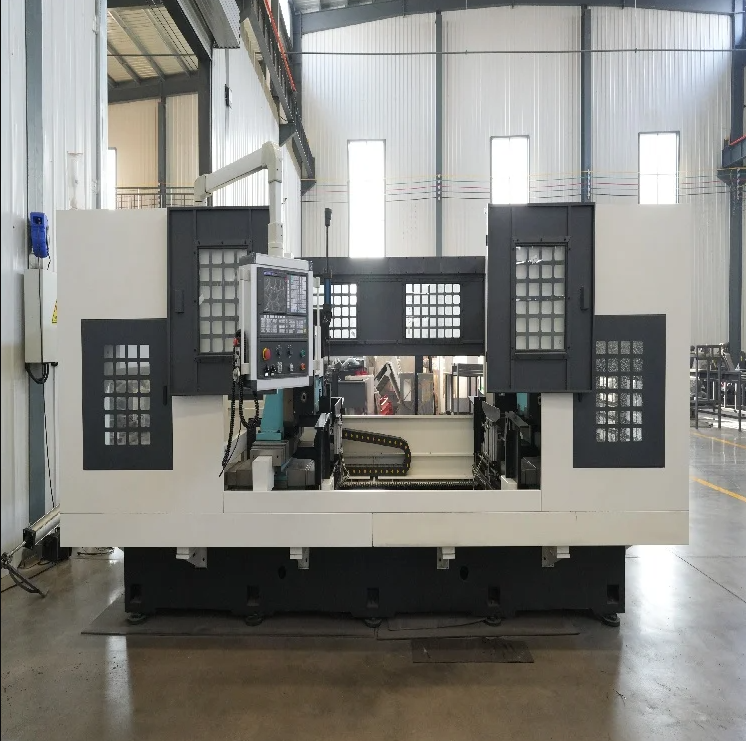
A CNC driller is a computer numerical control machine built to make holes with speed, repeatability, and accuracy. Instead of turning handwheels, the operator loads a program, sets the tool offsets, and lets the control system move the spindle along the commanded path. The machine can drill, spot, chamfer, ream, and sometimes tap in one setup. That sounds simple until you compare it with manual drilling. On a manual drill press, the operator hears the tool, feels the feed, and checks the depth by eye. On a CNC driller, the depth, feed rate, spindle speed, and position come from numbers. The result is a hole that lands in the same place on part one and part ten thousand. For shops that make mining roller shafts, axle parts, or hydraulic rods, that repeatability is not a luxury. It is the foundation of profitable production.
How a CNC Driller Works on the Shop Floor
Here is the thing about CNC drilling. The machine does not think. It follows instructions. A typical setup includes a rigid bed, one or more spindles, servo motors, ball screws, linear guides, a tool changer, and a control unit such as FANUC or GSK. Hydraulic clamps hold the workpiece so it cannot move during cutting. The control reads G code and sends pulses to the drives. Those drives position the tool, then the spindle rotates at the programmed speed. Coolant clears chips and controls heat. On a double head or double spindle design, two ends of a shaft can be drilled at the same time. That cuts handling time and improves concentricity because the part is not flipped between operations. In practice, a shop that drills both ends of a shaft in two separate steps often fights alignment errors. A dual end machine removes that fight.
Key Applications Across Heavy Industries
CNC drillers show up wherever holes must be accurate and repeatable. Mining equipment uses them for roller shafts, crusher parts, and conveyor components. Automotive suppliers drill axle shafts, piston rods, steering components, and transmission parts. Aerospace shops use CNC drilling for structural fittings and engine hardware where hole quality affects fatigue life. Medical device makers drill bone screws, surgical instruments, and implant components. Hardware and energy companies rely on CNC drilling for flanges, valves, and pump bodies. The common thread is not the industry name. It is the need for position accuracy, surface finish, and consistent cycle time. A hole that is off by a few thousandths may be acceptable in a garden gate. It is not acceptable in a mining roller shaft that carries heavy load or an aerospace part that faces vibration. That is why application review matters before a machine is chosen.
Efficiency Gains and Precision That Matter
Efficiency in CNC drilling is not only about faster spindle speed. It is about total cycle time. Loading, clamping, drilling, retracting, and unloading all count. A dual spindle or double head CNC driller can process two ends at once, which often doubles throughput compared with a single spindle lathe or drill. Industry data from machine tool builders and manufacturing associations such as SME shows that reducing setups lowers labor cost and improves quality. Many modern CNC drillers hold IT6 to IT7 tolerances when the process is stable. That level of precision supports press fits, bearing seats, and threaded connections. Hydraulic clamping adds repeatability because every part sees the same holding force. Automatic loading and unloading takes the operator out of the danger zone and lets one person run several machines. The business case is simple. More parts per shift, fewer scrap events, and less dependency on highly skilled manual drillers.
Choosing the Right CNC Driller for Your Parts
Choosing a CNC driller starts with the part, not the brochure. What is the material. How deep is the hole. What diameter and tolerance. Is the hole on one end or both ends. How many parts per month. A shop that drills short holes in small batches may not need a dual spindle monster. A shop that drills long shafts for mining or automotive customers may need a machine with a long bed, hydraulic clamping, and dual end capability. Ask about control compatibility, tooling supply, spare parts, and training. A CE marked machine helps with market access, but it does not replace a careful risk assessment. Test cuts on real parts are worth more than a spec sheet. Look at chip evacuation, coolant delivery, and how easy it is to change tools. Those details decide whether the machine makes money or becomes a bottleneck.
Manufacturing Support from Hengxing
Good equipment is only part of the story. A reliable partner matters just as much. Shandong Hengxing Heavy Industry Technology Co., Ltd., known as Hengxing, builds CNC double head lathes, CNC double head drilling machines, and double sided automatic milling machines. Hengxing serves mining, automotive, aerospace, and precision machinery customers with a quality management system and a growing overseas service network. The company exports to more than thirty countries and regions, including the Netherlands, Brazil, Canada, India, Indonesia, Vietnam, and Turkey. For buyers, that means presales consultation, customized design, long term technical support, and transparent spare parts supply. If a shop needs to drill both ends of a shaft with high accuracy and lower labor cost, Hengxing can discuss the process and propose a configuration. That kind of support turns a machine purchase into a production advantage.