
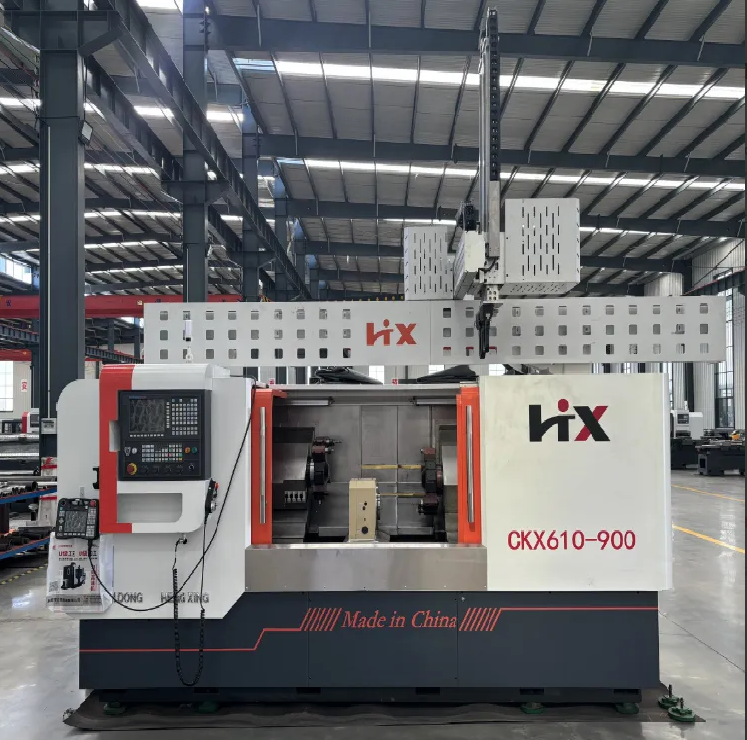
Structural Foundation of Slant Bed Rigidity Advantage
The core rigidity gap between slant bed CNC lathes and traditional flat bed models originates from fundamental body layout and casting structure design. A slant bed forms a stable triangular stress bearing frame when observed from the side view, lowering the whole machine gravity center and expanding the effective cross section of the bed casting to boost anti bending and anti torsion capacity significantly. Technical whitepaper released by China Mechanical Engineering Society confirms that standard forty five degree slant bed layout can reduce cutting vibration amplitude by more than thirty five percent compared with flat bed lathes of equal specification. High rigidity lathe bodies adopt one piece HT300 cast iron molding with secondary aging treatment to eliminate internal casting stress and prevent slow deformation after years of continuous production. The technical testing team of Hengxing Heavy Industry has completed thousands of on site cutting tests for automotive piston rods and mining roller shafts, recording obvious dimensional fluctuation on flat bed equipment under heavy feed parameters while slant bed prototypes maintain consistent dimensional tolerance range. Finite element analysis technology is applied during early product development to optimize internal rib distribution inside the bed, avoiding hollow weak zones that become vibration sources during high load turning. Large standardized casting workshops support integral molding production without split bed assembly that weakens overall structural rigidity, laying solid physical foundation for long term stable precision output.
Dynamic Stability Performance During Heavy Cutting Operations
Dynamic stability reflects how the whole machine resists instantaneous impact force generated by deep cutting and high speed rotation, which directly decides finished part surface quality and tool service life. On slant bed structures, cutting force vector overlaps with workpiece gravity direction to create natural preload on guide rail surfaces, eliminating extra lateral vibration that widely exists on flat bed lathes where cutting force acts perpendicular to workpiece weight. Global manufacturers processing automotive axle and mining shaft parts follow unified IT6 to IT7 precision standards for finished workpieces, which can only be steadily achieved on well optimized slant bed CNC equipment. A practical production case from a mining component cooperative factory shows that flat bed lathes produce obvious periodic tool marks when processing alloy steel roller shafts with twelve millimeter single cutting depth, while slant bed double head lathes from Hengxing Heavy Industry keep smooth surface texture without visible vibration traces. Stable dynamic performance also lowers tool wear speed effectively, extending usable tool life by nearly thirty percent for hard alloy cutting tools used in stainless steel and alloy steel processing. Four axis linkage hydraulic double spindle design further balances torsion load during simultaneous two end machining, avoiding unbalanced force distribution that damages long term structural stability of the machine body.
Thermal Stability Control for Long Duration Continuous Machining
Long hour non stop batch processing accumulates heat from spindle bearings servo drive motors and linear guide friction pairs, and uneven thermal expansion becomes one major factor damaging dimensional stability of machined parts. Slant bed layout creates natural heat dissipation space below the inclined guide surface, preventing heat stagnation between moving components and the bed base that easily occurs on enclosed flat bed structures. IDC global machine tool market research report proposes clear evaluation standards for thermal stability, requiring dimensional drift within three micrometers after twenty four hours of continuous full load cutting for high grade slant bed lathes. Machines lacking effective thermal control will show gradual circularity error and inconsistent axial size as operating time extends, raising product scrap rate and increasing production cost for manufacturing workshops. Slant bed lathes with high rigidity design integrate optimized heat isolation structures between spindle boxes and cast bed bodies to slow heat transfer into main structural components. Many overseas medical equipment and aerospace part manufacturers share feedback that slant bed CNC equipment maintains consistent micron level positioning precision even under high temperature workshop environment, greatly reducing frequent calibration work required for flat bed machine alternatives.
Core Component Matching That Reinforces Overall Structural Stability
Strong bed rigidity cannot deliver full performance without matching high rigidity auxiliary components that form a complete stress transmission system. High precision roller linear guide rails and large diameter ball screw pairs bear repeated reciprocating cutting loads, and their preload accuracy directly influences the overall anti vibration capacity of slant bed lathes. Hydraulic double spindle units with thickened bearing sleeves provide stable rotational rigidity for two end synchronous machining, avoiding spindle radial runout that destroys workpiece concentricity. All core functional parts on Hengxing Heavy Industry double head slant bed lathes follow ISO and CE international certification standards with strict incoming inspection before assembly. Statistical data collected from over six hundred long term cooperative manufacturers shows that matched original component combinations keep machine stability unchanged after five years of daily heavy load operation, while mixed low grade replacement parts trigger frequent vibration and precision decline within one year. Servo driven multi station tool turrets with wide contact surface increase clamping rigidity during cutting, preventing slight turret displacement that leads to uneven cutting depth on long shaft workpieces.
Common Misjudgments When Evaluating Lathe Rigidity and Stability
Many workshop procurement personnel hold misleading judgment standards when selecting CNC lathes, simply equating total machine weight with reliable rigidity while ignoring internal structural optimization details. A heavy split assembly bed with sparse internal ribs will still generate severe vibration under heavy cutting no matter how much total weight it carries, while reasonably reinforced thin wall integral cast slant beds achieve better stability with controlled overall weight. Buyers can complete simple field testing without professional measuring instruments to verify stability performance. Running full feed cutting on solid alloy blanks and observing workpiece surface texture can quickly identify obvious vibration defects; measuring dimensional difference of ten consecutive finished parts checks short term stability consistency. Another common misunderstanding assumes high speed operation equals good structural performance, but true slant bed rigidity manifests more obviously under low speed heavy cutting scenarios for mining and construction machinery components. Professional purchasing teams from European and Southeast Asian auto parts factories prioritize finite element structural reports and continuous cutting test data rather than only checking basic machine parameters during factory inspection visits.
Mature Manufacturing Capacity Delivers Consistent Rigidity Standard
Mastering slant bed rigidity and stability design principles is only half the solution, stable large scale manufacturing capacity guarantees uniform structural performance for every delivered machine unit. Hengxing Heavy Industry owns a fifty thousand square meter standardized production base with complete casting machining and assembly workshops, supporting full independent production of double head slant bed CNC lathes without outsourced core body processing. Eighteen years of accumulated ODM and OEM research and manufacturing experience enables the technical team to customize slant bed structural optimization schemes matching different processing materials including aerospace alloy medical stainless steel and mining thick shaft blanks. The brand builds a complete global service network covering more than thirty countries and regions, supplying transparent spare parts inventory and long term equipment upgrade technical support for overseas distributors and processing factories. A strict multi link quality control system monitors every casting machining and assembly procedure to unify rigidity and thermal stability standards across all product batches. Global bulk processing clients gain comprehensive support ranging from pre sales customized structural design to after sales long term stability maintenance guidance, relying on consistent slant bed lathe rigidity performance to lower production scrap rate and improve long term equipment return on investment.
Table of Contents
- Structural Foundation of Slant Bed Rigidity Advantage
- Dynamic Stability Performance During Heavy Cutting Operations
- Thermal Stability Control for Long Duration Continuous Machining
- Core Component Matching That Reinforces Overall Structural Stability
- Common Misjudgments When Evaluating Lathe Rigidity and Stability
- Mature Manufacturing Capacity Delivers Consistent Rigidity Standard