The True Nature of Custom Machining Work
Real custom part machining has nothing in common with standing at a machine and running ten thousand identical bushings. It is a completely different business rhythm. You might face a rush order for three hydraulic valve bodies made from duplex stainless on Monday, and by Wednesday, you are wrestling with a dozen gear blanks made from case-hardened 8620 steel. I walked into this trap early in my career, believing a standard production lathe could handle everything if we just tried hard enough. The result was constant setup chaos, missed delivery dates, and profit margins that simply evaporated into the cost of idle machines. A single-spindle CNC lathe intended for custom work must be a platform designed for agility from the casting up. You must honestly define the boundary of your “core part family”, the extreme diameter, the most demanding internal bore, the strangest thread form. If the machine cannot pivot between these extremes with minimal friction, your custom shop will never scale.
Why Quick Changeover Drives Profit in Short Run Work
Profitability in custom machining rarely comes from the actual chip-making time; it lives in the empty minutes between jobs when the spindle is not turning. I saw a small specialty shop struggling to survive on short-run oilfield parts. A typical setup change on their old lathe consumed four hours of skilled labor, dialing in offsets and swapping heavy jaw sets. After they invested in a single-spindle lathe with a quick-change tooling interface and a wedge-bar type chuck that allowed jaw swaps in under a minute, their changeover time collapsed to around twenty minutes per job. This directly freed up enough capacity to pick up three new customers without a second shift. The principle is pure lean manufacturing, akin to Shigeo Shingo’s Single-Minute Exchange of Die method. The machine must allow you to separate internal setup from external preparation, letting an operator preset tools on a bench while the lathe is still cutting the previous job. That is how you turn small batches into big profits.
The Programming and Control Advantage
When every job is a unique geometry, your CNC control unit is either a helpful translator or a frustrating barrier. I remember a situation that burned an entire weekend. We needed to machine a specialty optical housing with a complex internal aspheric curve on a lathe whose control simply lacked the necessary macro B functions. What should have been a mathematically elegant subroutine became a brutal, week-long project of manually approximating the curve with hundreds of tiny steps. For custom parts, you need a control system that speaks fluent G code and offers advanced functions like polar coordinate interpolation and customizable canned cycles out of the box. Critically, the simulation environment on the panel needs to be graphically rich and genuinely reliable, allowing you to dry-run the weird geometries on screen before ever risking a tool collision. This visual confidence prevents scrap on expensive one-off castings, directly guarding your trust and profit on every unusual part.
Tooling and Workholding Agility
The physical interface where your tool meets the turret and your part meets the spindle is the exact point where most custom machining plans fail. A BMT turret, with tools bolted rigidly into a precision coupling, offers supreme stiffness for heavy cuts on tough forgings. A VDI system, with its rapid serrated clamping, brings blazing speed for a shop that flips through several different turning, drilling, and milling tools per day. There is no universal right answer, only the right choice for your part mix. I spent hours early on fabricating awkward, application-specific fixtures for a single run of hydraulic manifolds. The game changed when we adopted a chuck system with an integrated quick jaw change mechanism. Having master jaws that could snap on a set of machinable soft jaws, or a special fixture plate, in just a couple of minutes meant we finally stopped chasing dial indicators and started making chips. Your workholding must be as flexible as your imagination.
Precision That Stays Put Across a Dozen Different Parts
A lathe that shifts its thermal geometry by even a few microns between morning and noon is a silent killer of custom part quality. In a day, you might machine a slender shaft from 304 stainless and then immediately switch to a rigid Inconel coupling. The spindle and ballscrews heat up differently under these varying loads, and a poorly compensated machine will drift, slowly and insidiously, out of tolerance. You won’t know until you measure the finished part. This is why insisting on a test report simulating a mixed-duty cycle, referencing the ISO 13041 standard, is non-negotiable. I learned this in a shop that shipped a certified first article in the morning, then got a tearful call from the customer when the afternoon’s second-off delivery scanned out of spec. The spindle’s thermal growth, completely predictable in hindsight, had quietly stolen the bore size by three microns. A properly designed lathe from an experienced builder uses active cooling and pretensioned ballscrews to slam the door on this chaotic thermal variation.
From Blueprint to Finished Part in Hours, Not Weeks
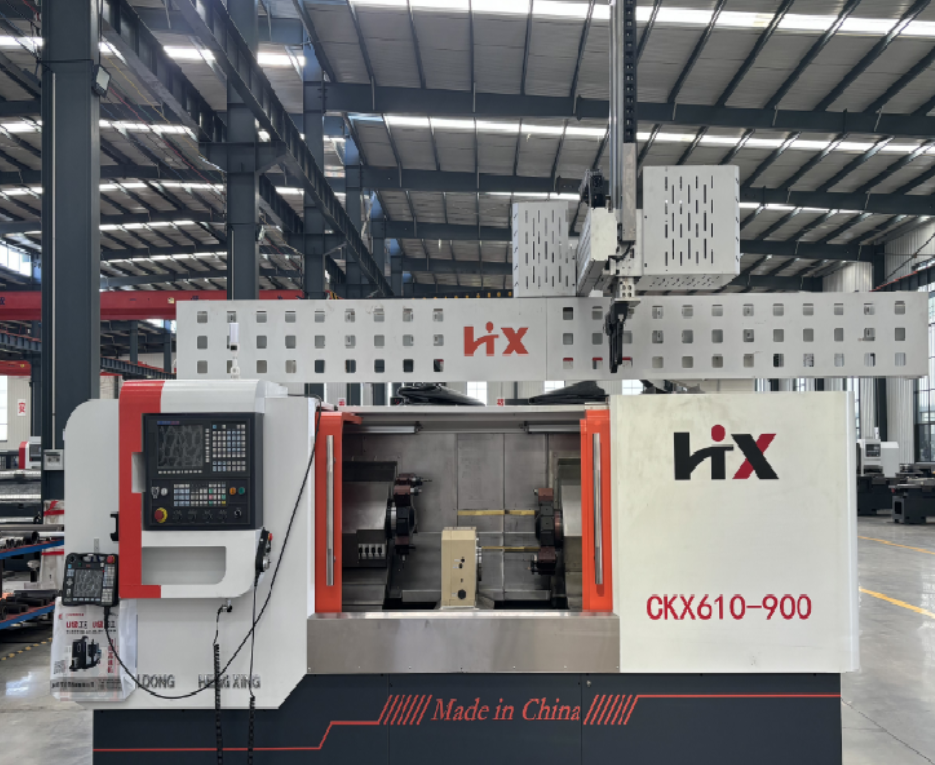
Over two decades of watching machine shops rise and fall, the winners in the custom parts game all share one trait: they can reliably turn a customer’s PDF into a certified, boxed part faster than anyone else. This speed is never an accident; it is built on the foundation of a single-spindle CNC lathe that is inherently adaptable, quick to set up, and thermally predictable. This is where a manufacturer’s depth of process control translates directly into your shop’s reputation. Companies like Hengxing, which oversee the entire manufacturing chain from the stress relief of massive iron castings to the precision hand scraping of guideways and final laser alignment, possess the vertical integration to understand every micro-detail of the machine’s capability. That depth means they can rapidly support you when a custom job demands a strange coolant manifold or a non-standard spindle nose adapter. The right machine builder becomes a silent but powerful ally, helping your shop deliver on the impossible, one custom part at a time.