
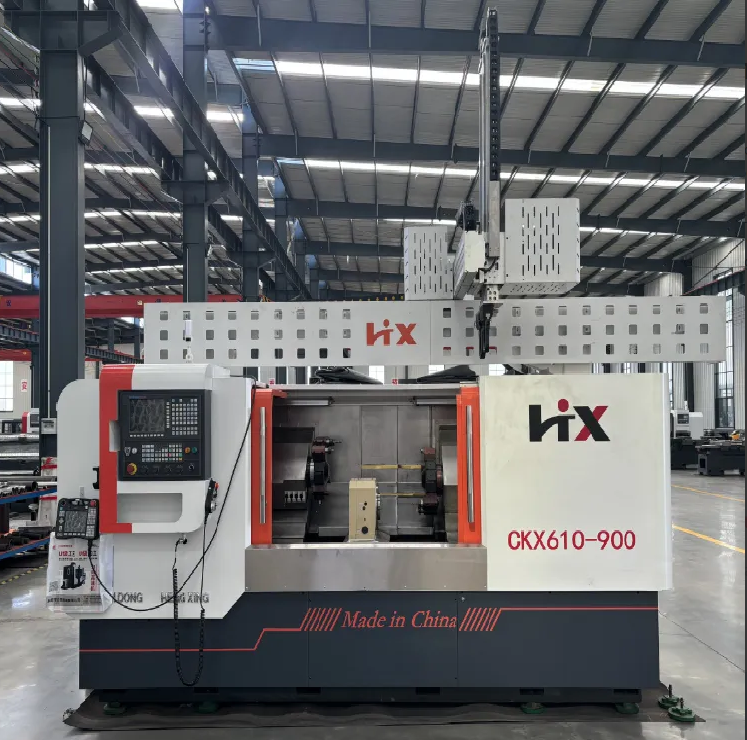
The Angle Does Half the Work, Not All of It
A slant bed gets credit for chip removal because gravity helps. On an automatic slant bed lathe, the guideways sit on an incline, so chips leave the cutting zone instead of sliding back across the saddle. That is real, but only half the story. The angle has to match the chip form. A 45 degree bed handles broken chips well. Long stringy chips from a deep groove or a soft sleeve can still wrap around the turret even on a steep bed. The base needs a clear path from the cutting edge to the conveyor, and that path changes when two heads are cutting at once. A machine with a good angle and a bad shield can still nest chips under the lower turret.
Where Chips Actually Go on a Twin-Head Machine
A double-head layout doubles the chip sources. Each turret throws chips in a different direction, and the lower head often sits in the shadow of the upper one. The slant helps, but the base needs separate slopes or a split conveyor so the two streams do not meet and pile up. Chip shields should be adjustable, because a shield set for one part can block the path for another. The goal is not a dry machine. The goal is a predictable path. When chips land in the same spot every cycle, an operator can clear them with a hook during a tool change. When they scatter, the cleanup becomes a hunt.
Coolant Pressure and Nozzle Aim Matter More Than Flow
High flow looks impressive, but chip removal depends on where the coolant hits. A nozzle aimed at the tool-chip interface can break a chip and push it down the slope. A nozzle aimed at the part center can flood the work zone and leave chips sitting in the trough. On a slant-bed automatic lathe, the best results often come from a mix of through-tool coolant and two or three adjustable nozzles. Pressure matters more than volume for clearing a deep pocket. Too much flow can also cool the headstock unevenly, which is a separate problem. The setup should be tuned on the actual part, not on a demo block.
A Sleeve Job That Exposed the Weak Spot
In a 2023 retrofit at a pipe fitting shop in Shandong, a twin-head slant-bed unit replaced two flat-bed machines. The first batch ran clean. The second batch, a long sleeve with a rough bore, started pushing chips under the lower turret. The bed angle was fine. The problem was a fixed shield that sent chips into a dead corner. A bolt-on deflector and a 20 degree nozzle change cleared the nesting. The shop also added a mid-shift conveyor check. The lesson is simple: chip removal is a system, not a bed angle. The same machine can run clean on one part and choke on the next if the shields and coolant are not matched to the chip form.
Thermal Drift Follows Poor Chip Evacuation
Chips that sit against the headstock or the ballscrew nut change the heat balance. A machine can hold size for two hours and then drift when a chip pile blocks coolant return. ISO 230-2:2014 gives a consistent way to test positioning accuracy and repeatability, and it is worth asking for a warm-machine check, not just a cold one. A 4-hour run with a thermal probe on the spindle nose and the ballscrew nut shows whether the chip path is stable. If the spread grows after lunch, the problem may be chips, not the servo. Good chip evacuation keeps the thermal picture boring, which is what a production shop wants.
What to Check on a Trial Cut
A trial cut should use a part that makes the same chip form as production. Hardness, wall thickness, and depth of cut all matter. Check these items with the conveyor running and the coolant at production pressure:
Chip buildup at the lower turret after 30 minutes.
Coolant return flow at the tank and at the chip conveyor.
Shield adjustability for the next part family.
Access to clear a nest without stopping both heads.
Thermal drift on the ballscrew nut after a 4-hour run.
The table below compares common chip removal outcomes. It is a shop-floor comparison, not a specification.
| Chip removal factor | Flat-bed pair | Slant-bed double-head unit | What to watch |
|---|---|---|---|
| Gravity assist | Low, chips sit on the saddle | High, chips fall away | Long stringy chips still wrap |
| Chip path with two turrets | Two separate machines | Shared base, needs split flow | Lower turret can be shadowed |
| Coolant aim | Often one flood nozzle | Multiple adjustable nozzles | Aim matters more than flow |
| Shield setup | Simple but fixed | Adjustable, part dependent | A fixed shield can create a dead corner |
| Cleanup access | Easy on open bed | Good if shields are removable | Check reach with both heads in place |
| Thermal stability | Drifts with chip piles | More stable when path is clear | Verify with a 4-hour run |
For a dual-spindle platform that handles roller shafts, pipes, sleeves, and similar work, Hengxing builds fully automatic double-head CNC lathes, double-head drilling machines, and double-sided milling machines around this chip path logic. The self-developed line and supply-chain support are worth reviewing when fixture iteration and spare-parts response are part of the purchase.