
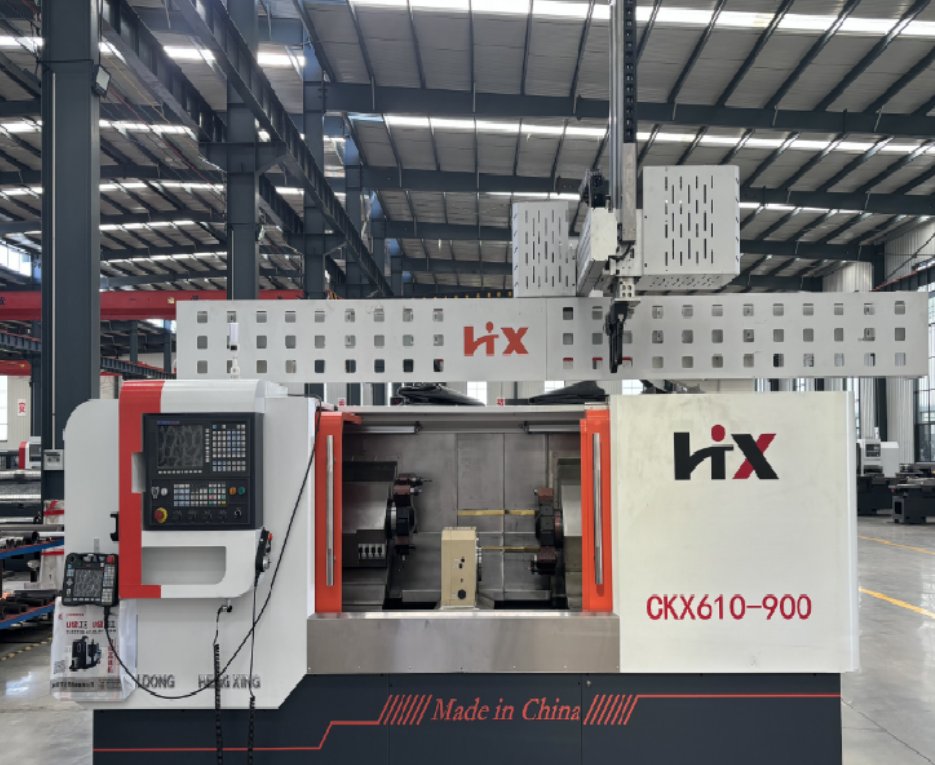
The Bed Angle Is a Load Path Decision
The choice between a flat bed and a slant bed on a double-head CNC lathe is not a style preference. It changes how cutting force travels into the floor, how chips leave the work zone, and how much floor space two operations consume. On an automatic slant bed lathe, the guideways sit on an incline, usually 45 or 60 degrees, so the turret and workpiece sit closer to the machine's mass center. That geometry can improve stiffness under a heavy roughing pass, but it also puts more demand on the base casting and rib layout. A flat-bed pair is simpler to build and easier to inspect, which is why many shops still run two flat-bed machines side by side for long shafts and heavy interrupted cuts. Neither layout wins everywhere.
Chip Control and Coolant Strategy Diverge Quickly
Chip removal is where the slant bed shows its practical advantage. Gravity pulls chips away from the cutting zone instead of letting them slide back across the saddle. On a twin-head machine, two turrets produce two chip streams, so the base needs separate slopes or a split conveyor. A flat-bed pair gives each operation its own chip path, which can be easier to manage when one part makes stringy chips and the other makes fines. Coolant aim matters more than flow in both layouts. A nozzle aimed at the tool-chip interface breaks the chip and sends it down the slope. A flood nozzle aimed at the part center can leave chips sitting in a trough. The slant angle helps, but shields and nozzle position finish the job.
Twin-Head Layout Changes the Fixture Conversation
A double-head machine is often chosen to cut op-10 and op-20 in one clamping strategy, or to turn both ends of a shaft against a shared datum. A slant-bed twin-head unit can reduce re-chucking and operator walking, especially when both heads are arranged for front access. The trade-off is fixture design. A weak jaw change system on a twin-head layout will drift just as badly as on two separate machines, and the shared base can make access tighter when a chip nest forms under the lower turret. A flat-bed pair gives more open access around each spindle, which matters for long slender parts that need tailstock support and frequent gauge checks. The fixture decision should be settled before the machine order, not after.
Thermal Behavior Separates a Stable Machine from a Fast One
High-speed machining is not a single number on a spindle nameplate. The structure has to support rapid acceleration without pitching the turret, and it has to hold size after the machine warms up. A shared slant base can help thermal stability because both heads sit on one structure, but the ballscrew on the upper head can still grow during a long run. ISO 230-2:2014 gives a consistent way to test positioning accuracy and repeatability of numerically controlled axes, and it is worth asking for a warm-machine check, not just a cold one. A 4-hour run with a thermal probe on the spindle nose and the ballscrew nut is more useful than a short demo. Flat-bed machines are not immune to heat, but each machine can be checked and compensated on its own.
Footprint, Maintenance, and the Cost of Ownership
Floor space is often the hidden decision maker. Two flat-bed machines usually need two footprints plus aisle space, crane clearance, and separate coolant tanks. A slant-bed double-head unit can compress two operations into one cell, typically 15 to 30 percent less floor space in common job-shop layouts. That gain is real, but maintenance access can suffer if the coolant tank and chip conveyor are tucked behind the base. A flat-bed pair is easier to service one machine at a time while the other keeps running. A twin-head slant-bed unit stops both operations when one head needs attention. The cost comparison should include fixture iteration, operator training, and spare-parts response, not just the purchase price.
A Selection Table and a Shop-Floor Case
In a 2023 retrofit at a pipe fitting shop in Shandong, a pair of flat-bed machines was replaced by a twin-head slant-bed unit. The first batch ran clean. A long sleeve with a rough bore then started pushing chips under the lower turret. The bed angle was fine. A fixed shield was sending chips into a dead corner. A bolt-on deflector and a 20 degree nozzle change cleared the nesting. The shop also added a mid-shift conveyor check and a warm-up cycle to control ballscrew growth. The case shows why the bed angle is only one variable. Chip path, shield adjustability, and thermal routine decide whether the machine runs clean over a full shift.
The table below is a shop-floor comparison, not a specification sheet.
| Factor | Flat-bed pair | Slant-bed double-head unit | Practical read |
|---|---|---|---|
| Load path under roughing | Simple, open frame | Inclined, compact mass center | Rib layout matters more than angle alone |
| Chip removal | Each machine has its own path | Gravity assist, needs split flow | Lower turret can be shadowed |
| Fixture access | Open around each spindle | Tighter with shared base | Long shafts favor open access |
| Floor space for two ops | Two footprints plus aisle | One cell, often 15 to 30 percent less | Check crane and service clearance |
| Thermal check | Per machine, easier to isolate | Shared structure, check both heads | Warm-machine test is essential |
| Maintenance while running | One machine can keep working | Both heads stop together | Spare-parts response matters |
Before signing off, a trial cut should cover the hardest combination of hardness, wall thickness, and tolerance. Check spindle alignment between heads, turret repeatability after 200 tool changes, chip buildup at the lower turret, and ballscrew growth after a 4-hour run. A slightly slower machine with clear access can outperform a faster one that hides the coolant tank behind the base.
For projects that need a dual-spindle platform rather than a single-purpose lathe, Hengxing builds fully automatic double-head CNC lathes, double-head drilling machines, and double-sided milling machines around shaft, pipe, sleeve, and roller work. The self-developed line and supply-chain support are worth reviewing when fixture iteration and spare-parts response are part of the purchase decision.