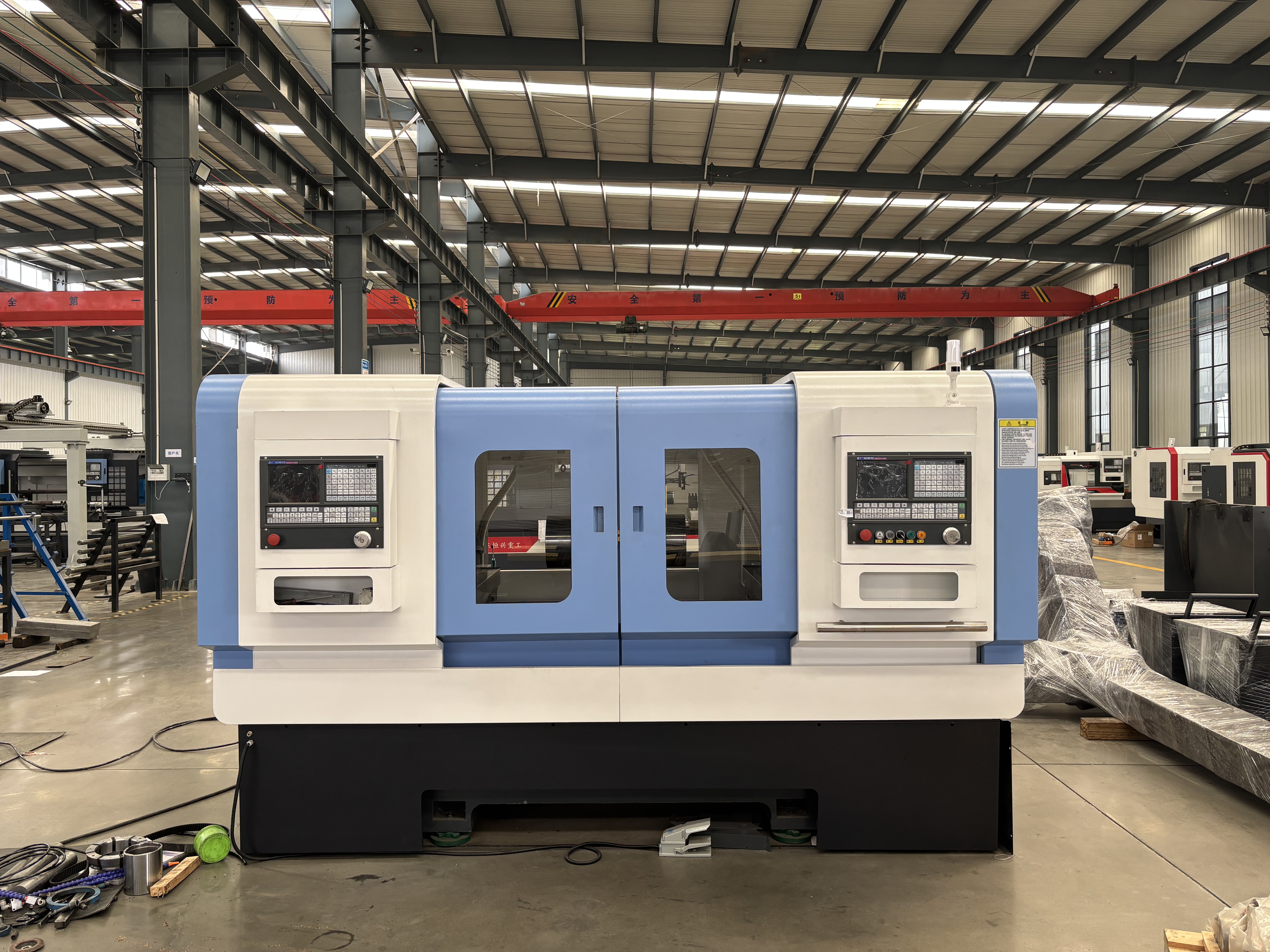
Spindle Lubrication and Thermal Management for Dual-Spindle CNC Lathes
Proper lubrication and thermal control are non-negotiable for maintaining precision in dual-spindle CNC lathes. Thermal deformation accounts for 65% of precision drift during extended operations, demanding rigorous protocols for each spindle zone.
Grease selection and replenishment protocols for independent spindle zones
Select high-viscosity synthetic greases rated for 15,000 rpm operations. Establish automated replenishment cycles every 400 machining hours using dedicated metering pumps per spindle. Monitor consumption through flow sensors to detect abnormalities—deviations beyond 12% trigger maintenance alerts.
Coolant flow calibration to mitigate differential thermal expansion
Calibrate coolant nozzles to deliver 6–8 GPM at 55°F (±2°) to each spindle independently. Asymmetric cooling causes dimensional drift exceeding 0.005 mm. Implement thermal sensors to dynamically adjust flow based on real-time spindle temperatures, maintaining thermal differentials below 4°F.
Oil-mist vs. centralized lubrication: performance trade-offs in high-cycle dual-spindle CNC lathe operations
Oil-mist systems reduce friction by 22% but require daily reservoir checks. Centralized lubrication extends service intervals to 700 hours but increases heat retention. Prioritize based on operational tempo:
| Lubrication Type | Cycle Frequency | Thermal Impact | Maintenance Load |
|---|---|---|---|
| Oil-mist | Best for <30s cycles | Low heat retention | High daily oversight |
| Centralized | Ideal for 2m cycles | Moderate heat rise | Quarterly servicing |
For high-precision dual-spindle operations under 60-second cycles, oil-mist delivers superior thermal stability despite increased maintenance.
Preventive Maintenance Scheduling Tailored to Dual-Spindle CNC Lathes
Condition-based vs. time-based intervals: insights from OEM service data
Condition based maintenance, or CBM for short, works by using sensors to watch what's happening in real time and only jumping in when things start going off track instead of following strict schedules. Looking at service records from equipment makers shows plants that switch to CBM tend to cut down on unexpected stoppages by around 20% compared to those stuck on regular maintenance calendars. The reason? Fixing problems before they actually break down saves headaches, plus nobody wants to tear stuff apart when everything's running smoothly. Take dual spindle CNC lathes as an example. These machines benefit a lot from CBM because it lets operators check each spindle separately. Small vibrations, weird temperatures, or uneven loads get spotted early enough so operators can fix them before synchronization issues mess up production runs.
Thermal warm-up protocols and stabilization windows for synchronized dual-spindle precision
Operators must implement structured warm-up routines to ensure both spindles reach identical thermal expansion states before high-precision machining. Standardized protocols involve:
- Gradually increasing spindle RPMs over 15–30 minutes
- Monitoring temperature differentials with infrared sensors
- Delaying tolerance-critical operations until thermal equilibrium (±1°C variance) is confirmed
Synchronized warm-up prevents micron-level positional drift between spindles caused by uneven heating cycles. Establishing stabilization windows—periods where no cutting occurs while temperatures normalize after pauses—further maintains dimensional consistency during long-duration jobs.
Alignment Verification and Guideway Protection on Dual-Spindle CNC Lathes
Maintaining precision alignment in dual-spindle CNC lathes requires specialized protocols to prevent dimensional drift. Machine shops report 47% fewer scrap parts when implementing rigorous verification cycles.
Laser interferometry and ballbar testing for inter-spindle axis synchronization accuracy
Laser interferometry measures positional deviations to 0.0001-inch tolerances, while ballbar testing evaluates circular interpolation errors between spindles. Synchronization drift exceeding 15 microns typically indicates worn thrust bearings requiring replacement per ISO 230-2 standards.
Wiper, guard, and debris management strategies for dual-spindle guideways and tooling zones
Implementing multi-stage debris management extends guideway lifespan by up to 80%:
| Protection Layer | Function | Maintenance Interval |
|---|---|---|
| Scraper wipers | Remove coarse chips | Daily inspection |
| Labyrinth seals | Block fine particulates | Quarterly replacement |
| Positive-pressure air curtains | Create particle barrier | Continuous operation |
Thermal isolation barriers between linear guide blocks and base structures prevent differential expansion—especially critical when machining high-thermal-resistance materials like Inconel®. Regular cleaning of dual-spindle tooling zones with non-abrasive vacuums preserves positioning repeatability below 5 microns.
FAQ
What type of grease should be used for dual-spindle CNC lathes?
High-viscosity synthetic greases rated for operations exceeding 15,000 rpm are recommended for dual-spindle CNC lathes.
What is the purpose of calibrating coolant flow in CNC lathes?
Calibrating coolant flow helps to mitigate differential thermal expansion, prevent asymmetric cooling, and ensure dimensional accuracy by reducing thermal drift.
What are the trade-offs between oil-mist and centralized lubrication systems?
Oil-mist systems reduce friction effectively and are suitable for short cycles but require more frequent maintenance. Centralized systems extend service intervals but can lead to increased heat retention.
Why is condition-based maintenance preferred over time-based maintenance?
Condition-based maintenance reduces unexpected stoppages by monitoring machine conditions in real-time, allowing maintenance to be performed only when necessary, which can lead to significant operational savings.
Why are structured warm-up routines important for dual-spindle CNC lathes?
Structured warm-up routines ensure that both spindles reach identical thermal expansion states, preventing positional drift and maintaining precision during machining operations.
Table of Contents
- Spindle Lubrication and Thermal Management for Dual-Spindle CNC Lathes
- Preventive Maintenance Scheduling Tailored to Dual-Spindle CNC Lathes
- Alignment Verification and Guideway Protection on Dual-Spindle CNC Lathes
-
FAQ
- What type of grease should be used for dual-spindle CNC lathes?
- What is the purpose of calibrating coolant flow in CNC lathes?
- What are the trade-offs between oil-mist and centralized lubrication systems?
- Why is condition-based maintenance preferred over time-based maintenance?
- Why are structured warm-up routines important for dual-spindle CNC lathes?