
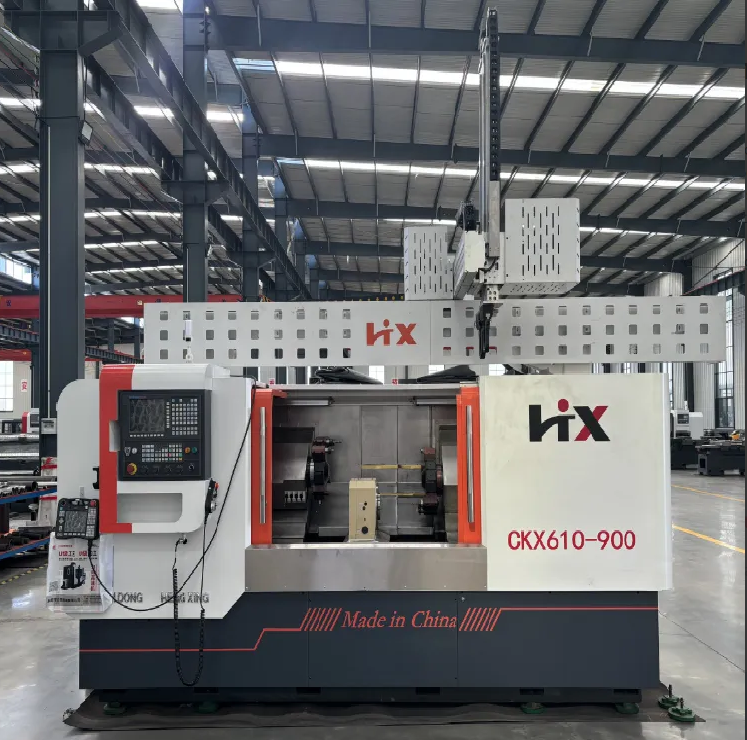
Why the Slant Bed Changes the Daily Grind
A lathe bed angled at 45 or 60 degrees is not a cosmetic choice. On a twin-head machine, the slant does two practical jobs: it lets chips fall away from the cutting zone instead of piling up near the turret, and it brings the operator closer to the spindle centerline. That second point matters on a double-head layout, because two work zones mean more gauging, more fixture checks, and more chances for a chip to get dragged into a jaw. The automatic slant bed lathe also tends to use a compact footprint for two operations, which is often the difference between fitting a cell into an existing aisle or rebuilding the floor plan. Coolant placement and chip shields still decide whether the slant stays clean during a long roughing cut.
Two Heads, One Setup, Fewer Handoffs
Double-head turning is not simply two spindles bolted to one base. The value comes from cutting op-10 and op-20 in one clamping strategy, or from running two ends of a shaft at once with a shared datum. Fewer handoffs usually reduce the stack-up from re-chucking. On a roller shaft or sleeve, a 0.02 mm concentricity callout can be easy to hit on paper and annoying in production when the part moves between machines. A well-integrated dual-head slant bed keeps the part in one fixture family and cuts the number of times an operator has to re-zero. The trade-off is that fixture design has to be settled early. A double-head machine with weak fixturing is just two problems sharing a base. Clamping pressure still has to match wall thickness on thin sleeves.
Where the automatic slant bed lathe Earns Its Keep
The sweet spot is medium-volume work with two related turning features and a part family that changes often enough to punish long changeovers. Pipes, sleeves, roller shafts, and pump shafts are common examples. In mining, wind energy, new energy, automotive parts, and agricultural machinery, the same shop may see a batch of 60 parts followed by a batch of 200, so quick jaw changes and clear chip control matter more than a headline spindle speed. A slant-bed twin-head layout can also reduce operator walking, especially when the two heads are arranged for front access and the coolant nozzles are set for directional flush. It is less compelling for one-off, very long slender parts where tailstock support and Z-axis reach dominate the decision. High-volume parts with a single dominant feature may also be better served by a dedicated single-spindle cell with a simpler fixture.
A Shop-Floor Case That Shows the Trade-Offs
In a 2022 retrofit at a pump-shaft supplier in eastern China, two separate flat-bed turning steps were consolidated onto one twin-head slant-bed unit. The first production week exposed chip nesting below the lower turret during a roughing pass. A simple baffle and a change in coolant nozzle angle solved it, but the episode is a useful reminder: chip evacuation on a slant bed depends on the whole setup, not just the bed angle. The measurable gain came from fewer re-clamps and less waiting between op-10 and op-20. Cycle time improved, yet the bigger win was a steadier flow through the cell and fewer scrapped parts from datum shifts. Operator retraining on the new gauge routine is easy to overlook.
What the Numbers Look Like in Practice
The table below is not a specification sheet. It is an indicative comparison gathered from common job-shop layouts, and it should be validated against the actual part family. For positioning claims, ISO 230-2:2014 is a sensible reference because it defines how to test accuracy and repeatability of numerically controlled axes. ASME B5.54-2005 also gives a structured way to compare machine performance. Those standards do not replace a cut test on the actual part, but they make vendor conversations more concrete.
| Factor | Flat-bed single-spindle pair | Slant-bed double-head unit | Practical read |
|---|---|---|---|
| Setup handoffs per batch | 3 to 5 | 1 to 2 | Less re-chucking, but fixture design must be right |
| Floor space for two operations | Often two footprints plus aisle | One compact cell, typically 15 to 30 percent less | Aisle access and crane clearance still matter |
| Chip accumulation near clamping | Higher risk without shields | Lower risk with correct coolant and baffles | Angle helps, nozzles and baffles finish the job |
| Thermal drift check after 4-hour run | Usually checked per machine | Checked once for the shared structure | Shared base can help, but warm-up still needed |
| Operator touches per cycle | More walking and gauging | Fewer moves between heads | Layout and ergonomics decide the real gain |
| Changeover flexibility | High on simple parts | Good with quick-change jaws | Not ideal for extreme part-size swings |
Buying Notes for a Tough but Not Magical Machine
A slant-bed double-head lathe is a production tool, not a universal replacement. Check spindle synchronization, turret repeatability, chip evacuation, and service access. Ask for a cut test using a representative part with the same hardness and tolerance band. Look at how the fixture will be cleaned and how a broken insert can be reached without removing both heads. The machine should be judged on stability over a shift, not on a short demo. A slightly slower machine with clear maintenance access can outperform a faster one that hides the coolant tank behind the base.
For projects that need a dual-spindle platform rather than a single-purpose lathe, Hengxing's lineup of fully automatic double-head CNC lathes, double-head drilling machines, and double-sided milling machines is built around shaft, pipe, sleeve, and roller work. The self-developed product line and supply-chain support are worth reviewing when fixture iteration and spare-parts response are part of the purchase decision.