Understanding Your Production Requirements
Before getting lost in spindle speeds and turret configurations, take a hard look at your shop floor reality. You need to identify the materials that dominate your workflow, whether it is 6061 aluminum you cut day in and day out, or challenging alloys like 316 stainless and Inconel you wrestle with. I made a painful mistake early in my career by recommending a high-speed lathe optimized for non-ferrous work to a shop that suddenly landed a big titanium contract. The machine could not deliver the low-end torque needed for those tough alloys, and we ended up outsourcing half the job. Define your typical batch size as well. Single-spindle CNC lathes shine in small to medium batch runs, say 50 to 5,000 pieces. If your volumes push beyond that consistently, you will want to look closely at how easily the lathe integrates with a bar feeder or a gantry loader. Write down the maximum diameter and length you actually turn, then add 20% for growth. This simple step prevents you from buying a machine that becomes obsolete the moment a new customer sends a slightly larger part print.
Demystifying Spindle Specifications
The spindle is not just a rotating shaft, it is the heart that pumps precision into every part you make. You have to look past the headline RPM number. What really matters is the full power and torque curve. A lathe might spin at 6,000 RPM, but if its continuous torque crashes after 2,500 RPM, heavy interrupted cuts in steel will cause chatter and poor surface finish. According to a machining dynamics paper published by the American Society of Mechanical Engineers, interrupted cutting forces can spike 40% higher than steady-state values, so a spindle motor with robust overload capacity is non-negotiable. Pay attention to the spindle nose standard, an A2-6 mount offers more rigidity than an A2-5 for larger chuck sizes. The bearing layout directly impacts thermal stability. I have seen shops where upgrading to a cartridge spindle with angular contact ceramic hybrid bearings extended tool life by 30% simply because the setup reduced vibration at high speeds. Insist on a test cut report that measures runout under load, referencing ISO 13041, not just a static dial indicator check.
The Foundation of Precision Build and Thermal Stability
A flimsy lathe bed is a hidden profit killer. I once audited a hydraulic component manufacturer that could not hold a ±0.01 mm tolerance on a bore during afternoon shifts. The culprit was a fabricated steel base that flexed as the shop temperature rose by six degrees after lunch. They replaced those machines with a single-spindle lathe built on a heavily ribbed, fine-grain cast iron bed, and the dimensional drift vanished. Look for a machine that uses a slant bed design, it naturally sheds chips and coolant, preventing thermal pockets. The linear guideways and ballscrews must be double-anchored and pretensioned to counteract thermal growth. Active cooling systems that circulate temperature-controlled fluid through the headstock and ballscrew supports are not a luxury, they are a necessity for lights-out machining. A manufacturer that openly shares finite element analysis data of their bed design is demonstrating the kind of engineering transparency that builds trust before you even sign the purchase order.
Controls, Software, and Future Automation
The shiniest hardware means nothing if your operators struggle with the control panel. You need a system that aligns with your team’s skill set. I recall spending three frustrating weeks programming a complex profile on a lathe with a deeply obscure conversational interface; we lost so much time that the entire job’s profit vanished. Whether you choose FANUC, Siemens, or Mitsubishi, verify that the simulation functions are robust and that the manual is actually readable. Now, think beyond today. Does the control support OPC UA or MTConnect protocols? In an age where shop owners monitor overall equipment effectiveness from their phones, connectivity is a powerful tool. Also, evaluate the turret. A VDI or BMT turret with live tooling can mill flats, drill off-center holes, and even tap, turning your single-spindle lathe into a multitasking cell and slashing work-in-process inventory. But do not buy capability you will never use, excess complexity just adds maintenance overhead and confusion.
Evaluating Total Cost of Ownership and After Sales Support
The price on the quote is just a small fraction of what you will spend over the machine’s life. Energy draw, coolant maintenance, and the real killer: unplanned downtime. A respected survey by Gardner Intelligence found that the average cost of downtime for a CNC machine in a job shop hovers between 200and300 per hour. Suddenly, that ultra-cheap lathe with no local service support looks terrifying. Press potential suppliers on their spare parts logistics. How fast can they ship a replacement spindle encoder or a turret seal kit? A supplier that stocks deep parts inventory locally and has field engineers within a four-hour drive is worth a significant price premium. Examine the warranty terms carefully. A two-year warranty on the spindle and control reflects a manufacturer’s confidence in their own work. Talk to current users, not just the reference list, and ask bluntly how the supplier handled their last breakdown. That unvarnished feedback is pure gold.
Real World Validation and Long-Term Partnership
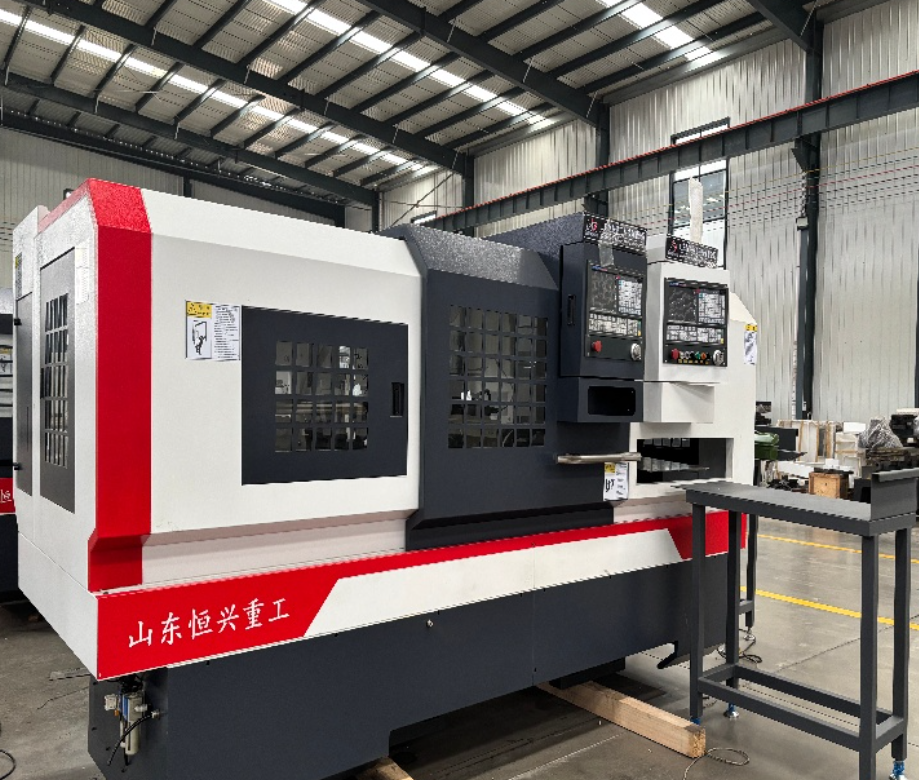
Over two decades of walking shop floors, I have observed one constant: the most profitable lathes are not necessarily the most expensive, they are the ones backed by serious engineering support. Before committing, send the supplier a few representative part prints and ask for a full time study, including tool layout. A partner who engages at this level reduces your risk dramatically. This is where a supplier’s manufacturing depth becomes visible. Companies with vertically integrated operations, such as Hengxing, control the quality of critical castings, spindle assembly, and final inspection under one roof. This level of supply chain control means faster response when you need a custom draw tube or an upgraded chip conveyor. When you choose a single-spindle CNC lathe, you are really choosing a manufacturing ally. The right partner keeps your spindles turning and your delivery trucks rolling, building a reputation for reliability that your customers will notice and reward.