It All Starts With a Rock Solid Foundation
Let me tell you something about precision machining that a lot of people overlook. You can have the fanciest control system in the world and the most advanced cutting tools money can buy, but if your machine is wobbling around like a wet noodle, nothing else matters. The very first secret to how a single spindle cnc lathe hits those tight tolerances is the foundation it sits on. And I am not just talking about the concrete floor in your shop. I am talking about the machine bed itself.
A quality single spindle cnc lathe is built on a heavy cast iron bed. Why cast iron? Because it has excellent vibration damping properties. When the spindle spins up to speed and the cutting tool starts biting into a piece of steel, vibrations happen. If those vibrations travel through the machine, they end up as chatter marks on your workpiece. That means rough surfaces, oversized dimensions, and parts that do not meet spec. Cast iron soaks up those vibrations like a sponge, keeping everything steady and true.
Many modern single spindle cnc lathe machines also use an inclined bed design. You will often see a 30 degree slant bed on these machines. That angle is not just for looks. It serves two important purposes. First, it helps with chip evacuation. Chips and coolant fall right down into the pan instead of piling up on the cutting zone. Second, a slant bed improves rigidity. The angled design lowers the center of gravity and distributes cutting forces more evenly through the machine structure.
Some manufacturers pay special attention to the guideways too. We are talking about hardened and precision ground guideways that let the turret and other moving parts slide with minimal friction. Hardened guideways are incredibly wear resistant. They keep their accuracy for years and years of heavy use. And when you combine that with high precision ballscrews for driving the axes, you end up with positioning accuracy that you can really count on.
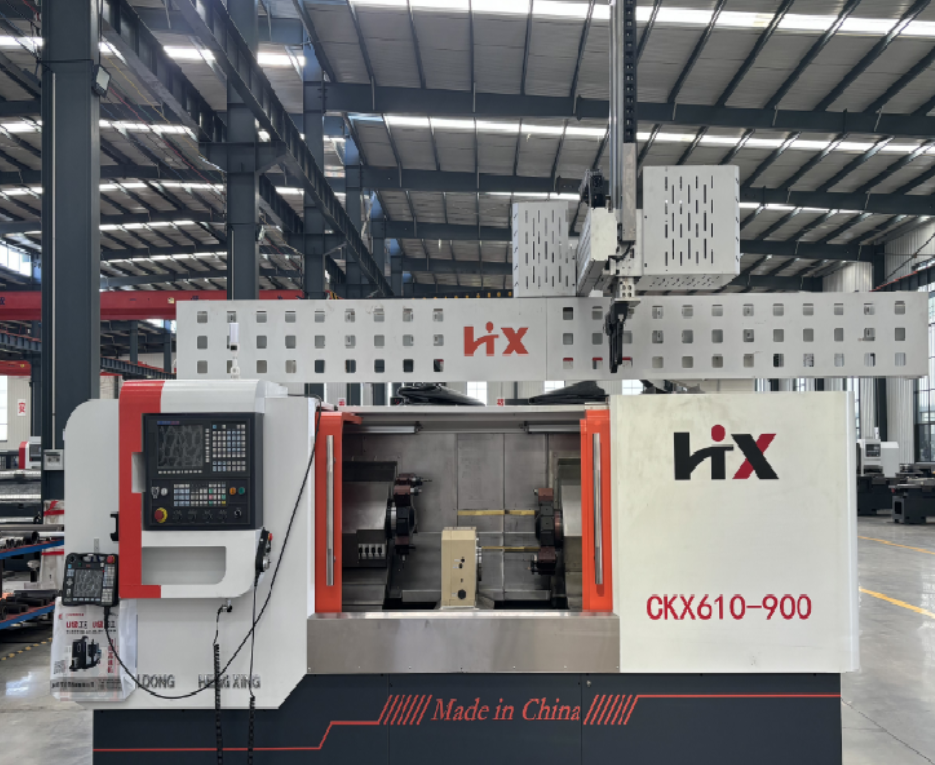
The website of Hengxing mentions that their single spindle double head CNC lathes are trusted by over 300 manufacturers in mining, automotive, and medical technology fields. That kind of real world adoption does not happen by accident. It happens because the machines are built on proper foundations that deliver stable performance shift after shift. So when you ask how a singlespindle lathe achieves high precision, the first answer is simple. A rock solid bed, quality guideways, and a design that keeps everything rigid and stable.
The Spindle Is Where The Magic Happens
Now let us talk about the heart of the machine. The spindle. This is the component that holds your workpiece and spins it while the cutting tools do their work. If the spindle is not up to the task, you have zero chance of achieving high precision. A good spindle on a single spindle cnc lathe machine is an engineering marvel. It has to spin at high speeds, sometimes thousands of revolutions per minute, while maintaining absolute concentricity.
What goes into a high precision spindle? First, the bearings. Quality spindles use super high precision angular contact ball bearings. Brands like NSK or NTN are common in the industry. These bearings are manufactured to extremely tight tolerances. They allow the spindle to rotate smoothly while supporting heavy cutting loads. Some manufacturers achieve spindle runout of less than two microns. That is an incredibly small number. For context, a human hair is about 70 microns thick.
The spindle motor matters too. Many modern singlespindle lathes use integrated spindle motors. The motor is built right into the spindle assembly. This eliminates belts and pulleys, which can introduce vibration and reduce efficiency. An integral spindle motor also provides better torque characteristics across the speed range. You get good low speed torque for heavy cutting and high speed capability for finishing passes.
Balancing is another critical factor. Every spindle is dynamically balanced before it leaves the factory. This process involves adding or removing tiny amounts of weight in specific locations to cancel out any imbalances. A perfectly balanced spindle spins smoothly without wobbling or vibrating. That smooth rotation translates directly into better surface finishes and more accurate dimensions on your parts.
Hydraulic systems often come into play here as well. Some single spindle cnc lathe machines use hydraulic chucks to hold the workpiece. Hydraulic clamping provides consistent, repeatable gripping force. Unlike manual chucks where the operator might tighten a little more or a little less each time, a hydraulic chuck applies the same force every single cycle. That consistency is huge for maintaining precision across long production runs.
The website mentions that their hydraulic single spindle double head CNC lathe delivers IT6 to IT7 precision for aerospace, mining, and auto parts. IT6 to IT7 is a precision grade that tells you exactly how accurate the finished parts will be. In metric terms, that level of precision means you are talking about tolerances measured in a few hundredths of a millimeter. That is plenty tight for almost any industrial application you can think of. Achieving that level of precision starts with a high quality spindle, plain and simple.
Smart Controls Turn Raw Power Into Repeatable Accuracy
Having a rigid machine and a great spindle is only half the battle. You also need a brain to coordinate everything. That is where the CNC control system comes in. A modern single spindle cnc lathe is essentially a computer hooked up to motors and sensors. The control system tells every part of the machine exactly what to do and when to do it. And it does this over and over again with amazing consistency.
Think about what the control system has to manage. It sends signals to the spindle drive to spin at a specific RPM. It sends commands to the servo motors that drive the X and Z axes to move the turret to precise locations. It controls the coolant pump, the hydraulic chuck, the automatic tool changer, and sometimes even a part catcher or bar feeder. All of these actions have to be perfectly synchronized. If the timing is off by even a fraction of a second, you could crash a tool into the workpiece.
The most popular control systems in the industry come from brands like FANUC, Siemens, and GSK. Each has its own strengths. FANUC is known for rock solid reliability and a huge installed base. Siemens offers powerful features for complex machining. GSK provides a good balance of performance and value. The website mentions that some of their machines are compatible with the GSK 980TB3i controller. That particular controller is well regarded in the industry for its stability and user friendly interface.
How does the control system actually help with precision? Two words: closed loop feedback. Every axis on a quality cnc lathe machine has an encoder. The encoder constantly monitors the actual position of the axis. If the commanded position and the actual position do not match even by a tiny amount, the control system immediately makes a correction. This feedback loop happens thousands of times per second. The result is positioning accuracy that you could never achieve with a manual machine.
Another important factor is acceleration and deceleration control. When an axis moves from one position to another, it has to speed up and slow down smoothly. Jerky motion creates vibrations and overshoot. A good control system uses sophisticated algorithms to generate smooth motion profiles. Some machines even have look ahead capability. The control system reads ahead in the program to anticipate upcoming moves and adjust acceleration accordingly.
Some of the single spindle cnc lathe machines on the market offer four axis linkage. That means the machine can coordinate movement on up to four different axes at the same time. Four axis linkage allows for complex contouring and simultaneous machining operations. This capability is especially valuable for aerospace and medical parts where you have curved surfaces and complicated geometries. But even on simpler parts, the smarts in the control system make a real difference in how consistent and repeatable your results are.
Certifications like CE compliance also speak to the quality of the control and safety systems. CE certification means the machine meets European standards for health, safety, and environmental protection. It is not a guarantee of precision by itself, but it does indicate that the manufacturer takes engineering quality seriously. And when you care about engineering quality, you tend to produce machines that hold their tolerances well over time.
Keeping Things Cool And Measuring Everything Twice
There is an invisible enemy that works against precision on any machining operation. Heat. When a cnc lathe machine runs for hours on end, everything heats up. The spindle gets hot from friction and the power it consumes. The ballscrews heat up from moving back and forth constantly. The cutting process itself generates huge amounts of heat that goes into the chip, the tool, and the workpiece. And when metal heats up, it expands.
Thermal expansion is a real problem for precision machining. A steel workpiece that is one foot long can grow by several thousandths of an inch if it gets hot enough. That might not sound like a lot, but when you are trying to hold a tolerance of a few hundredths of a millimeter, thermal growth can easily push your part out of spec. So how do single spindle cnc lathe manufacturers deal with this challenge?
The first line of defense is effective cooling. Most machines use flood coolant that washes over the cutting zone constantly. The coolant lubricates the cutting action, washes away chips, and carries heat away from the workpiece and tool. Some machines use high pressure coolant that shoots directly at the cutting edge for even better cooling. And many spindles have their own dedicated cooling systems to keep the bearings at a stable temperature.
But cooling alone is not enough. Good machine design also minimizes heat generation in the first place. Pre loaded bearings and properly adjusted guideways reduce friction. Efficient drive systems waste less energy as heat. And some manufacturers incorporate thermal compensation features into their control software. The software monitors temperatures at key points on the machine and automatically adjusts axis positions to compensate for thermal growth.
The foundation we talked about earlier also plays a role here. A massive cast iron bed acts as a heat sink. It absorbs heat slowly and distributes it evenly throughout the structure. This prevents hot spots from developing and keeps the machine geometry more stable. Even if the entire machine warms up gradually, it tends to stay true because everything expands together at roughly the same rate.
Now let us talk about measurement and verification. You cannot hit a target you cannot see. A quality single spindle cnc lathe machine is equipped with precision scales or encoders on each axis. These devices measure position with incredible accuracy. Some use glass scales that read laser etched lines. Others use magnetic or optical encoders. The key is that the machine knows exactly where it is at all times.
Before a machine ever leaves the factory, it goes through rigorous testing. Manufacturers follow standards like ISO 13041 for testing geometric accuracy and machining performance. They use laser interferometers to measure positioning accuracy and repeatability. They run test cuts and measure the results with coordinate measuring machines. Only when a machine passes all these tests does it get shipped to a customer.
And here is something many buyers do not think about enough. The initial accuracy of a machine is important, but long term accuracy is what really matters. A well built single spindle cnc lathe machine will hold its calibration for years with proper maintenance. The bed stays straight. The guideways stay flat. The spindle bearings stay true. That kind of durability comes from using high quality materials and proper manufacturing processes. It is the reason why machines from reputable manufacturers, like the ones trusted by hundreds of OEMs in mining and automotive sectors, keep running and holding tolerances for decades.
So the next time someone asks you how a single spindle cnc lathe achieves high precision turning, you can tell them it is not just one thing. It is the rigid bed, the high quality spindle, the smart control system, the thermal management, and the rigorous quality testing, all working together. Get any one of those elements wrong, and your precision goes out the window. Get them all right, and you have a machine that can produce perfect parts all day long, every single day. That is the magic of a well engineered cnc lathe.