Why Accuracy and Speed Define Modern Drilling
In today’s manufacturing world, a hole is never just a hole. It is a fit, a function, and a promise that the next part will work the same way. A CNC driller sits at the center of that promise. When a shop drills a mining roller shaft or an automotive axle, accuracy and speed decide whether the order is profitable or painful. A few thousandths of an inch can mean the difference between a bearing that seats perfectly and a customer complaint. Speed without accuracy creates scrap. Accuracy without speed loses contracts. The best CNC drillers deliver both, and that combination is what separates a busy shop from a competitive one. From the fitting bench to the production line, the lesson repeats. A machine that holds tolerance and cuts cycle time pays for itself long before the warranty ends.
The Mechanics Behind CNC Drilling Accuracy
Accuracy in CNC drilling does not happen by accident. It comes from a chain of rigid, controlled systems. The bed must absorb vibration. The linear guides must move without play. The ball screws must translate servo rotation into precise linear motion. The spindle must hold the tool with minimal runout. The control unit, whether FANUC or GSK, must process feedback and correct position in real time. Hydraulic clamping adds another layer because every workpiece sees the same holding force. When these elements work together, a CNC driller can hold IT6 to IT7 tolerances. That range supports press fits, bearing seats, and threaded connections that must survive heavy load. Industry experts at SME and major machine tool builders often point out that repeatability, not just maximum speed, is the true measure of a drilling system. A machine that hits the target once is interesting. A machine that hits it ten thousand times is valuable.
Speed Advantages from Dual Spindle and Dual Head Design
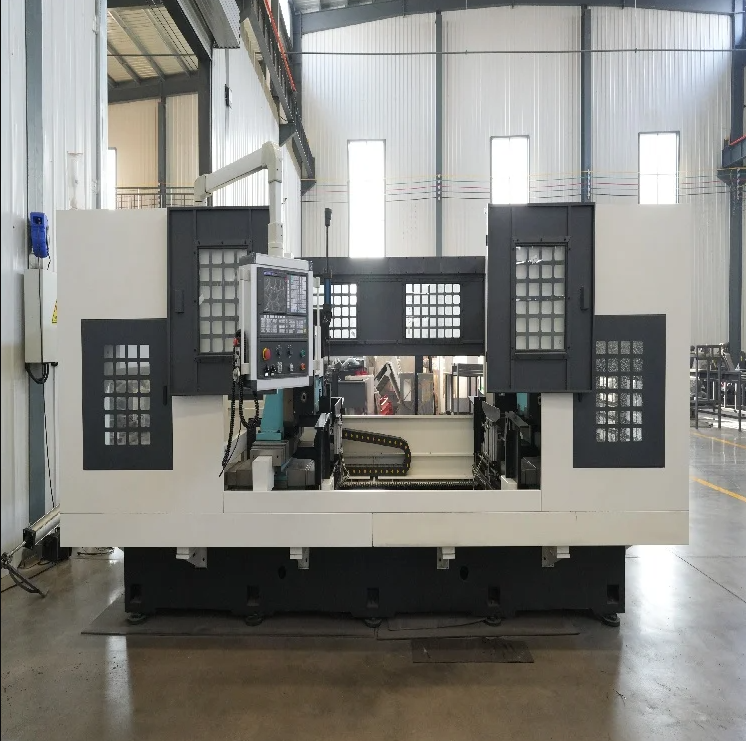
Speed in CNC drilling is not only about spindle RPM. It is about total cycle time. Loading, clamping, drilling, retracting, and unloading all eat into production. A dual spindle or double head CNC driller changes the math. It can process both ends of a shaft at the same time. That means one setup instead of two. One clamp instead of a flip. One alignment instead of a chance for error. Shops that switch from single spindle lathes to dual spindle machines often report up to two hundred percent higher throughput. The part never leaves the fixture between operations, so concentricity improves and handling time drops. Automatic loading and unloading takes the operator out of the cycle, which allows one person to run several machines. Coolant delivery and chip evacuation are designed to keep cutting continuous. The result is simple. More parts per shift, less labor per part, and a shorter lead time for every order.
Real World Gains on the Production Floor
A familiar scene plays out in heavy industry. A shop drills long shafts for mining equipment. The old process uses a manual drill press for one end, then a second setup for the other end. Alignment is a constant fight. Scrap rates climb. The skilled operator who can hold tolerance is retiring. Then the shop invests in a dual end CNC driller with hydraulic clamping. The first week is a learning curve. By the second month, cycle time is cut in half. Hole position is consistent. The operator now monitors two machines instead of wrestling one. The business case is not theoretical. It is measured in reduced overtime, lower scrap, and on time delivery. Authoritative sources such as the Association for Manufacturing Technology note that automation and multi tasking machines are key drivers of productivity growth. The same principle applies here. When accuracy and speed arrive together, the entire production floor feels the difference.
Choosing a CNC Driller That Delivers Both
Choosing a CNC driller starts with honest questions. What material is being drilled. How deep is the hole. What diameter and tolerance. Is the hole on one end or both ends. What is the monthly volume. A shop that drills short holes in small batches may not need a dual spindle machine. A shop that drills long shafts for mining or automotive customers may need a long bed, hydraulic clamping, and dual end capability. CE certification helps with market access, but it does not replace a careful risk assessment. Test cuts on real parts are worth more than any brochure. Look at chip evacuation, coolant delivery, tool change time, and spare parts availability. Shandong Hengxing Heavy Industry Technology Co., Ltd., known as Hengxing, builds CNC double head lathes, CNC double head drilling machines, and double sided automatic milling machines. Hengxing serves mining, automotive, aerospace, and precision machinery customers with a strict quality management system and an overseas service network that reaches more than thirty countries, including the Netherlands, Brazil, Canada, India, Indonesia, Vietnam, and Turkey.
Partnering for Long Term Productivity
Accuracy and speed are not one time purchases. They are relationships. A machine that runs fast today but loses tolerance next year is a liability. A partner that provides presales consultation, customized design, long term technical support, and transparent spare parts supply is an asset. Hengxing understands this balance. The company supports customers from the first process discussion through prototype testing and mass production. When a shop needs to drill both ends of a shaft with high precision and lower labor cost, Hengxing can propose a configuration that fits the part and the budget. That kind of collaboration turns a machine purchase into a production advantage. For buyers who value both precision and throughput, the right CNC driller is more than equipment. It is a step toward stronger margins and happier customers.